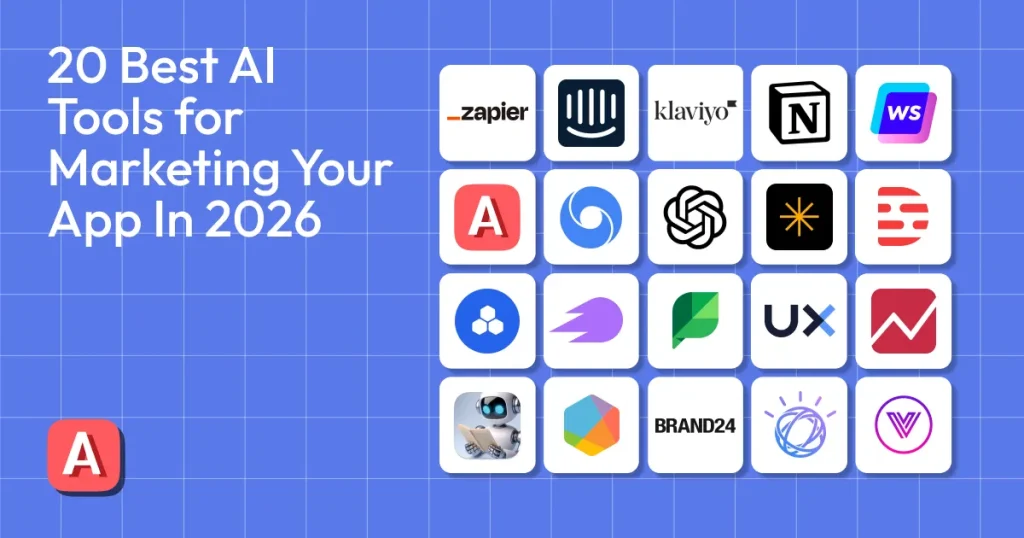
Boost app growth with the 20 best AI marketing tools of 2026. Master ASO, automate retention, and scale faster with expert picks for indie devs and growth teams
AI app marketing tools are tools specifically designed for app marketing, helping teams handle tasks such as research, creatives, copy, and analysis faster. They work by taking over repetitive tasks so you can focus on decisions and growth.
This blog covers 20 top AI Marketing tools used in AI app marketing, including AppLaunchpad, Maze, Claude, Semrush, and Jasper. These tools support everything from idea validation and keyword research to creating app store visuals and understanding user feedback.
These tools aren’t random picks. Each one is selected based on four criterias real impact on app growth (ASO, conversion, retention), genuine AI-driven automation, ease of use for small teams, and the ability to scale as your app grows.
Key Takeaways
Validate your app idea early using real user feedback instead of relying on assumptions.
Use Semrush and AppTweak to identify high-demand keywords and uncover gaps your competitors are missing.
Don’t rely on a single creative, consistently generate and test multiple variations to find what actually converts.
Your screenshots, app icon, and preview videos directly impact installs, so treat them as performance assets.
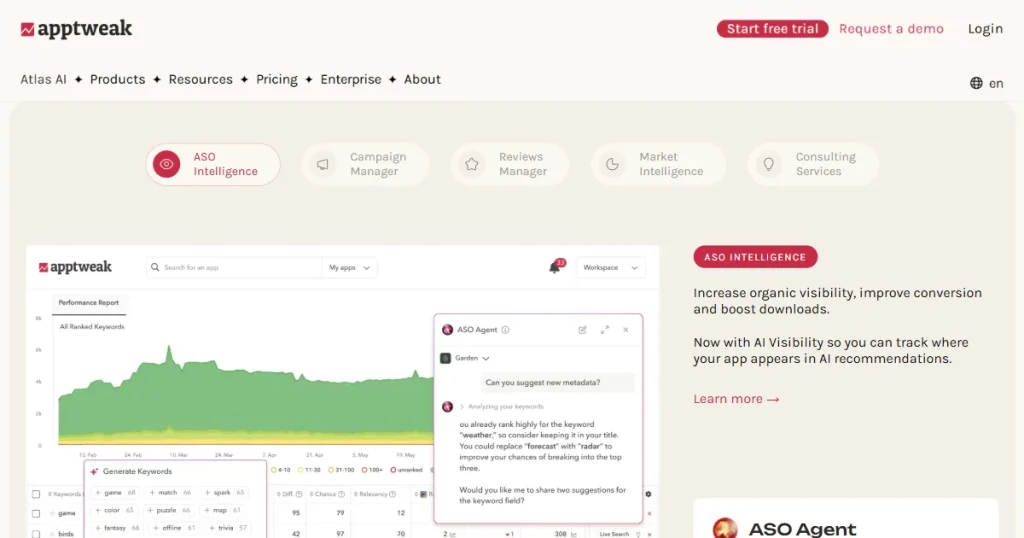
Localizing your screenshots and metadata can quickly unlock new markets and increase organic downloads.
Ads fatigue fast, so keep refreshing your creatives to maintain performance across platforms.
Track how your app appears in AI search tools to stay visible in the new discovery landscape.
Use user reviews and sentiment tools to uncover real issues and improve both product and messaging.
Let AI handle repetitive execution, but keep human control over strategy and positioning.
Choose tools that are easy to adopt, deliver real impact, and can scale as your app grows.
What Are AI Marketing Tools?
The tools listed here aren’t just standard automation scripts. AI app marketing tools use machine learning and generative models to handle the manual work of copywriting, creative design, and complex data analysis.
Think of them as a force multiplier, they don’t replace your marketing strategy, but they do cut your execution time from weeks down to mere hours.
In 2026, the real advantage comes from using AI app marketing tools to run faster experiments and improve App Store optimization.
You can test hundreds of ad hooks while your competitors are still working on their first few.
The secret ingredient, however, is human oversight. You still need to be the one steering the ship to make sure the AI doesn’t drift off-brand.
20 Best AI App Marketing Tools in 2026
AI app marketing tools
Stand-out feature
Drawback
Maze
Automated usability testing with heatmaps and AI pattern recognition
Heavily reliant on prototypes rather than live app environments
Claude
Research Mode that synthesizes pain points from Reddit and Quora
Simulated user personas may lack the unpredictability of real users
Semrush
Competitor intelligence to identify white-space keyword gaps
Steep learning curve due to the massive volume of data and metrics
AppLaunchpad
One-click localization of store screenshots into dozens of languages
Limited to pre-built templates and less creative freedom than Figma
appicons.ai
Generates 6 distinct professional icon styles from a text description
May require multiple credit uses to refine a specific artistic vision
Midjourney
High-resolution cinematic art with advanced style and lighting control
Interface can be clunky for some users since it is Discord-based
Typefully
Text formatting that stays intact when pasted into stores
Highly specialized for short-form copy rather than long-form content
Jasper
Brand Voice training to maintain consistency across all marketing copy
Can produce generic results if not guided by specific user inputs
Atlas AI (AppTweak)
Semantic Relevancy Score to ensure keywords match app context
Focused strictly on ASO and has limited utility for general web SEO
Google Veo
Native 4K video generation with integrated audio and voiceovers
High-quality rendering can lead to usage quotas or wait times
RunwayML
Image-to-Video tool that turns static screenshots into cinematic ads
Advanced features and high-res exports require a paid subscription
Kling AI
Ultra-smooth transitions for realistic UI animations
Clip lengths are limited to short 5-15 second bursts
Lokalise
AI orchestration that selects the best engine per language
Pricing can scale quickly for apps with massive shifting codebases
AppTweak
Spy tool for finding high-volume keywords rivals have abandoned
Focused on store data and lacks broader social or web metrics
Otterly AI
Tracks brand visibility and recommendations within Google AI Overviews
Newer niche with evolving strategies that may change frequently
Rankscale
Monitors brand citations and sentiment inside ChatGPT and Gemini
Success relies on third-party site authority beyond your control
Reviewmind
Automated SWOT analysis derived from thousands of user reviews
May overlook technical edge-case bugs in favor of trends
Brandwatch
Real-time global monitoring of brand buzz across the entire internet
Enterprise-grade pricing is often too high for early-stage startups
IBM Watson NLU
Enterprise-grade emotion detection via API
Requires technical or developer expertise to integrate and interpret
AI Marketing Tools for App Idea Validation & User Behavior Research
These tools help you validate ideas early and understand real user behavior before investing in development.
1. Maze
Maze is the go-to AI app marketing tool for people who hate guesswork. Maze is the go-to AI app marketing tool for people who hate guesswork. It lets you test your app prototype with real users to see how they behave before investing money.
Key Features
Automated usability testing: You can share test links and watch users try your prototype, see how users interact with it, and track their journey.
Heatmaps and session recordings: You’ll see exactly where users are clicking or getting stuck, making it easy to spot and fix the dead ends.
AI-powered analysis: This AI marketing tool automatically filters out qualitative feedback to find recurring patterns so you don’t have to read every single comment manually.
Question AI Follow-Up: Maze can generate dynamic follow-up questions based on user responses, finding deeper and better insights.
Diverse research methods: From card sorting to 5-second tests, you get a full suite of tools to check your app’s first impressions and user preferences.
Best for
App UX validation and user behavior analysis.
Finding issues in your app before you decide to launch.
How can you use it for app marketing?
Test your app’s onboarding to see where users drop off within the first 30 seconds of use. This way, you will save hours of work and cut your ad budget on users who never made it to the main dashboard.
2. Claude
Claude is an AI app marketing tool that has become a founder favorite for vibe-checking ideas and organizing the messy data you find in subreddits and Quora forums. You can conduct quick market research to analyze real pain points from real user reviews.
Key Features
Research mode: Claude can scan thousands of Reddit posts, Quora forums, and G2 reviews to find the exact pain points users are complaining about in a timely manner.
Multi-persona simulation: Ask Claude to act as five different user types to critique your idea, giving you a complete view of potential market risks.
Constraint-based idea generation: Give Claude clear limits like budget and timeline, and it will help you shape your idea into a simple, validated MVP.
Pre-order page generation: Use Clause to draft the copy and basic code for a demo landing page to see if people will actually pay before you build.
AI-driven evaluation: Use the Claude Console evaluation tool to run your business logic across multiple scenarios, ensuring your strategy is working.
Best for
Validating app ideas and market research.
Use reviews from Reddit, G2, and Quora to build a clear strategy.
How can you use it for app marketing?
Use Claude to find common complaints in your app niche based on real user feedback, then analyze them to identify the biggest pain points. Use these insights to write an ad headline that directly addresses the main frustration.
3. Semrush
Semrush is the bread and butter of market analysis, helping you figure out exactly what people are typing into search bars before you commit to a niche.
Key Features
Keyword & Ranking Analysis: See the specific keyword terms your rivals are ranking for so you can copy, use, or replicate their best traffic sources.
Competitor Intelligence: It breaks down your competitor’s app listing (app title and description), showing you exactly where they’re winning and where they’re failing.
ASO & ASA Optimization: Get data-backed suggestions using advanced insights to tweak your store listing or Apple Search Ads for maximum app store visibility.
Market Trend Monitoring: This AI tool tracks global shifts in search behavior and market trends so that you can pivot your app’s focus before a trend peaks.
Competitive Gap Analysis: Identify and target the keywords that everyone else is ignoring, simplifying the process for organic growth.
Best for
App demand validation and market research.
Monitoring on competitor traffic and keyword strategies.
How can you use it for app marketing?
Before you build an actual app (e.g., an AI study planner app), check if people are actually searching for it. If an alternative field (e.g, Homework Helper) has 10x the demand, you should change your app naming strategy to capture that existing traffic.
AI Marketing Tools for Static App Store Visuals & Creative Generation
These tools focus on creating high-quality visuals that improve conversion rates on your app store listing.
4. AppLaunchpad
If you aren’t a designer or a big Figma fan, AppLaunchpad app screenshot generator is a lifesaver. It turns the hectic work of creating 50 different screenshot sizes into a ten-minute task.
Key Features
No Design Skills Needed: Use a simple drag-and-drop editor to make high-end screenshots that are created by professional designers.
Pre-Built Templates: Choose from 1000+ screenshot templates that are already optimized for App Store and Google Play Store, whether you’re making a game or a fitness app.
Automated Device Support: This AI tool supports everything from the iPhone 17 Pro Max to Android tablets, scaling your designs to meet both App Store screenshot guidelines and Google Play Store requirements.
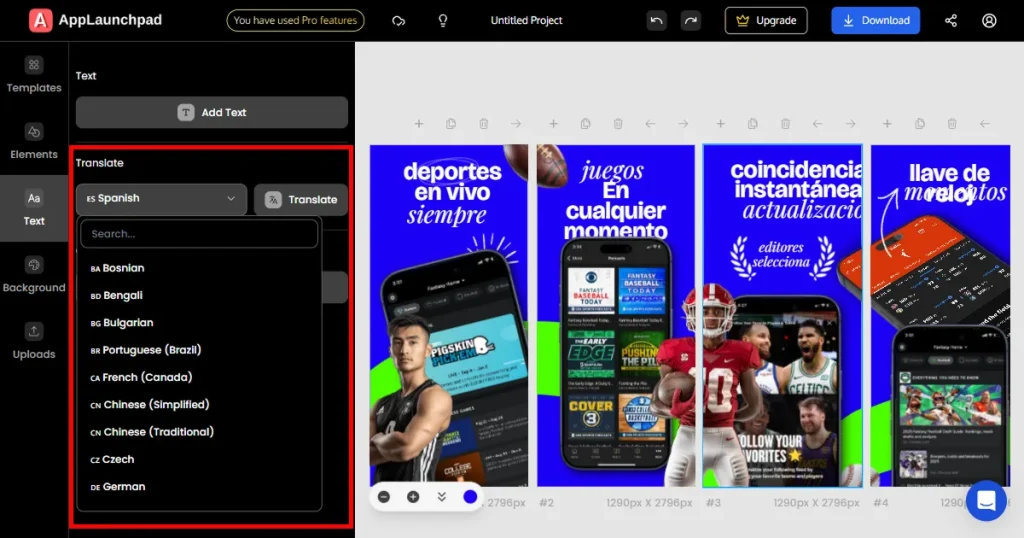
One-click localization: Instantly translate your screenshot text captions over 80+ languages , allowing you to launch globally without an external translator.
Brand Customization: You can easily add your own logos, hex colors, and custom fonts to make sure your store listing looks and feels like your brand.
Best for
ASO asset creation and screenshot design.
Rapidly localizing your app store presence for global market expansion.
How can you use it for app marketing?
You can build a complete set of App Store and Google Play Store screenshots. Additionally, you can add high-fidelity 3D device mockups and handheld device visuals to make your app look real and premium to users.
5. Appicons.ai
Your icon is the face of your app. Appicons is an AI app marketing tool you can use to generate dozens of professional app icons in seconds, at a lower design cost.
Key Features
AI-Driven Design: Just describe what your app does, and the AI generates six different icon styles for you to choose from.
Customization & Editing: You can preview, edit, and upscale your chosen app icon to 2048×2048 px for high-quality. Moreover, you can refine the edges and colors of the icon using the image-to-image tool.
Commercial Use Licensing: Every icon you generate is yours to keep and safe for any commercial use, which is a must for any real business.
Export & Integration: Icons are exported in high-resolution 1024×1024 PNGs that work perfectly with the auto-scaling tools in Xcode and Android Studio.
User-Friendly Workflow: This AI marketing tool uses a simple credit system so you can keep experimenting until you find the icon that feels right.
Best for
App Icon design and early-stage branding.
Testing different visuals before committing to one.
How can you use it for app marketing?
Generate 5 different icon styles, from 3D to flat, and run a quick social media poll. Let your audience tell you which one they’d be more likely to click on.
6. Midjourney
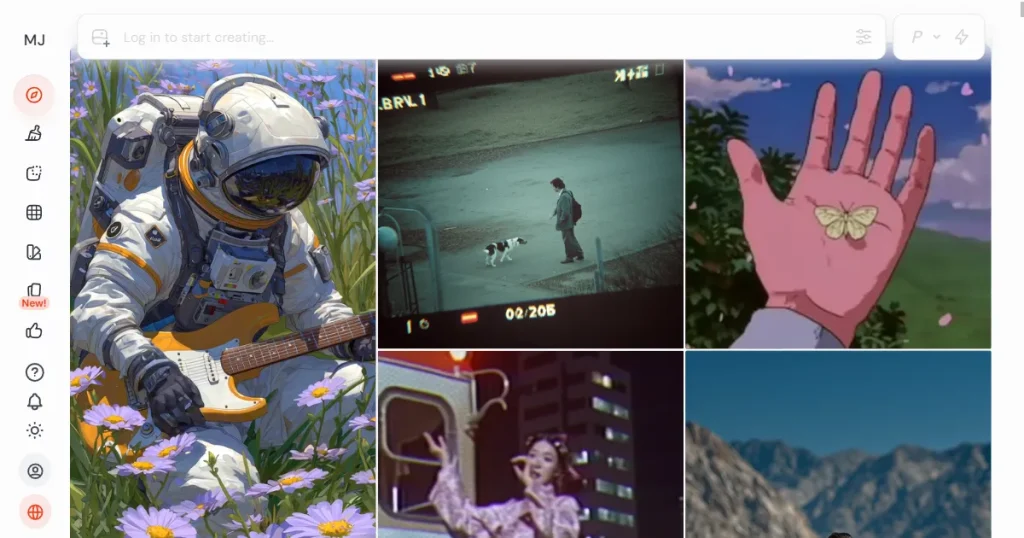
For high-end art marketing, Midjourney is still the most popular AI app marketing tool for images and video creation. It’s how you get those premium-looking hero images without hiring an expensive photographer.
Key Features
High-Resolution Image Generation: Create incredibly detailed cinematic art from simple text prompts for your website or store listing.
V7 Model Consistency: The latest version 7 is much better at maintaining style consistency across multiple images, which is great for brand consistency.
Built-in Upscalers: Sharpen and refine your images directly in the tool so they look crisp even on the largest 4K displays.
Style and Lighting Control: You can tell this AI tool exactly what kind of mood you want, from moody neon to bright and airy.
Compatible with External Tools: These images play well with other AI upscalers if you need to go all the way up to billboard-sized resolution.
Best for
Premium marketing visuals and landing page hero images.
Creating consistent brand imagery for social media ads.
How can you use it for app marketing?
Prompt Midjourney for a cinematic photo of a runner at sunrise to give your site an instant professional upgrade.
AI Marketing Tools for App Store Copy & Messaging
These tools help you write clear, persuasive copy that communicates your app’s value and improves installs.
7. Typefully
Formatting is the secret to getting people to actually read your marketing copy. Typefully is an AI app marketing tool that helps you write punchy, formatted text for places that usually don’t allow it.
Key Features
Text Formatting Tools: Easily add bold, italics, or emojis to your text copy, making your screenshot captions pop in the App Store.
Preserved Formatting: It keeps your formatting intact when you copy and paste, so your carefully crafted bullet points don’t turn into a mess.
Workflow Automation: You can sync it with Zapier to auto-format your social posts or even schedule them in advance.
Dedicated X Editor: Provides a clean, distraction-free space to write X threads and posts to help build your brand image.
Clean Drafting Experience: The interface is clean and highly focused on speed, helping you focus on the leading hook without all the usual platform clutter.
Best for
Writing well-formatted text captions for App Store screenshots.
Managing short-form copy for App Launch and social media campaigns.
How can you use it for app marketing?
Use Typefully to make the main feature in your screenshot caption BOLD. A simple visual shift can make a user stop scrolling and actually read your content.
8. Jasper
Jasper is your marketing department in a single platform. It’s designed to write longer, more persuasive text that sounds like it was written by an actual writer.
Key Features
Template-Driven Creation: Use proven frameworks for app descriptions that focus on solving problems rather than just listing specs.
Brand Voice Consistency: You can train Jasper on your own writing style so every email and description sounds exactly like you.
SEO Optimization: It suggests the right keywords to include so your landing pages actually show up when people search on Google.
Content Improver: Feed it a boring draft, and it will rewrite the whole thing to be more exciting and punchy in seconds.
Multi-language Support: It can think in over 25 languages, helping you create localized copy that doesn’t sound like a bad translation.
Best for
Long-form app descriptions and landing page copy.
Maintaining a consistent voice as your team grows.
How can you use it for app marketing?
Take your dry technical app description and ask Jasper to make it benefit-driven. It will turn a list of features into a story that makes users want to download your app.
9. Atlas AI by AppTweak
ASO is a numbers game, and Atlas AI is your calculator. It helps you find the specific keywords that the store algorithms actually care about and rank for.
Key Features
Relevancy Score(0-100): This score tells you if a keyword is actually relevant to your app. Targeting the wrong words is a sure way to get buried in the rankings.
Semantic Understanding: Unlike others, Atlas AI understands how keywords and apps connect in context, helping you rank for groups of words rather than just one.
Metadata Simulator: Test multiple metadata drafts, character usage, and see real-time changes in Total market searches(TMS) and KPI reach so that you can draft better titles and subtitles.
AI Keyword Clustering: It groups related search keywords to help you dominate an entire niche rather than just one keyword.
Missing Keyword Detection: It scans your draft and points out high-traffic keywords you forgot to include, ensuring your listing is fully optimized.
Best for
Optimizing app titles and subtitles for organic reach.
Finding high-potential long-tail keywords that competitors missed.
How can you use it for app marketing?
Before you launch an update, check your Relevancy Score. If your new subtitle only scores a 50, Atlas AI can help you swap in keywords that will increase the score to 90 and boost your app visibility.
AI Marketing Tools for App Preview Video, Ads & Demos
These tools turn your app into engaging video content that captures attention and boosts ad performance.
10. Google Veo
In 2026, App preview videos have become increasingly common. Almost all apps are now using promo videos to attract potential users. Google Veo is an AI app marketing tool that lets you make 4K ads using nothing but your imagination and a few prompts.
Key Features
App Preview Creation: Turn your feature list into a realistic video of someone using the app, showing off the UI in a natural setting.
Ad Video Generation: Veo 3.1 lets you create scroll-stopping social media ads by converting ad copy into realistic ad videos. These videos come with voiceovers and background music that match your brand.
Realistic Physics and Lighting: Veo 3.1 follows real-world physics, ensuring shadows and motion look natural so your ads don’t have a fake AI look.
Native Audio Support: This AI marketing tool generates its own background music and voiceovers, so you don’t have to hire actors or buy stock audio.
Creative Control: You can extend/remove clips or change styles in real time, making it easy to test multiple creative directions for your next campaign.
Best for
Professional-grade app store preview videos.
High-quality social media ads for YouTube, TikTok, and Instagram.
How can you use it for app marketing?
Generate a 30-second lifestyle ad of someone using your app in a coffee shop. It’s a lot cheaper than a film crew and looks just as good in the App Store.
11. RunwayML
RunwayML is a high-end motion graphics studio that works right in your browser. It’s the fastest way to turn a boring, static screenshot into a high-end, premium video that actually stops people from scrolling past your ads.
Key Features
Text-to-Video: You just describe a scene in plain English. The AI builds a custom clip from scratch, which is a lifesaver when you need b-roll videos but don’t have a camera handy.
Image-to-Video: Drop in your app mockups in this AI marketing tool. The AI adds cinematic pans and zooms, making flat images look like a big-budget commercial ad.
AI-Powered Editing: It lets you brush out messy backgrounds or random objects in seconds. You can also add a style to your video, like cinematic and vintage, text overlays, and background music.
Rapid Iteration: You can create multiple videos for A/B testing. It’s the best way to see what visual style actually keeps users from swiping away.
Ready-to-Post Exports: Export videos in MP4 and WebM formats, optimized for Instagram Reels, Stories, and YouTube. No more fiddling with aspect ratios right before a launch.
Best for
Converting flat screenshots and images into high-performance video ads.
Testing multiple visual hooks on social media without a massive ad budget.
How to use it for app marketing?
Take a screenshot of your app’s strongest feature and add a subtle, slow zoom. That tiny bit of motion makes the UI feel alive, which usually leads to much better click rates on social media platforms.
12. Kling AI
Kling AI is all about the feel of your app. This AI app marketing tool specializes in ultra-smooth, realistic animations that show potential users exactly what it’s like to navigate your app interface in real life.
Key Features
Frame-to-Frame Control: You pick the start and end points for the video. The AI then invents the transition in between, making the flow look natural and effortless.
Flow Generation via Text: Describe the app interface, key features, and a specific user journey (e.g., a person checking out an item), and the AI builds a video that follows that exact narrative.
Reference Consistency: You can upload up to seven UI mockups in Kling 01. This ensures the branding stays consistent and doesn’t introduce weird elements that aren’t part of your actual product.
Controlled Camera Work: It adds professional light shifts, zooms, and pans to highlight specific UI elements without distracting from the main content.
Algorithm-Friendly Lengths: This AI marketing tool generates clips of 5-15 seconds, which is well within what the App Store expects.
Best for
Creating professional App Store preview videos that look premium.
Explaining complex app features through easy-to-follow motion and camera zooms.
How to use it for app marketing?
Make a 10-second video of a user finishing a task. When people see that Success screen pop up with smooth, rewarding motion, it creates a psychological sense of win that encourages them to hit download.
AI Marketing Tools for App Localization
These tools help you adapt your app and assets for different languages and markets, enabling global scale.
13. Lokalise
If you aren’t localizing your app in 2026, you’re essentially leaving money on the table and missing hidden opportunities. Lokalise takes the headache out of managing app localization across 50 languages in seconds.
Key Features
The Translation Hub: Lokalise keeps every language file in one place. Your devs and translators are always on the same page, working on the most recent version.
Smart AI Orchestration: The platform selects the best translation engine (e.g., GPT-4o, DeepL) for specific language pairs, generating accurate translations.
Dev-Friendly Workflow: It integrates directly with GitHub and Figma, enabling real-time sync. Your app gets updated in new languages as quickly as you can push code.
QA & Glossaries: The AI double-checks for technical fails like a German translation being too long to fit. It also ensures that the brand tone stays consistent across languages and markets.
Batch Scaling: For large projects (40+ languages), Lokalise supports branching workflows, batch editing, and bulk imports and exports.
Best for
Breaking into international markets with minimal effort.
Automating the translation cycle for large projects (40+ languages) or fast-moving mobile apps.
How to use it for app marketing?
You can use Lokalise for global projects with features such as branching, bulk exports, and batch editing. When you speak to users in their native tongue, they connect with your app better.
14. AppLaunchpad
Localizing your screenshots is one of the easiest hacks to rank on the App Store. AppLaunchpad lets you translate your store visuals into dozens of languages without you ever having to open Photoshop or Figma.
Key Features
One-Click Localizing: Pick your target language, and the AI translates and adjusts your text so it fits properly without overlapping the UI, supporting 80+ languages.
Smart Layouts: It automatically resizes and adjusts the text layout so it doesn’t overlap with the device mockup, even when a translation is much longer than the original English.
Sync Across Devices: If you change a font color in your English set, the tool automatically pushes that change to other languages.
Saved on cloud: It keeps everything organized. Your projects are saved automatically, and you can revisit them anytime for further revisions and editing.
Store-Ready Files: Download a ZIP with every size and language required. The localization is fully compliant with App Store and Google Play screenshot guidelines.
Best for
Rapidly localizing store assets for new markets.
Maintaining a consistent brand vibe across different languages.
How to use it for app marketing?
You can easily localize a complete set of screenshots into multiple languages with a single click. The AI-powered localization tool accurately translates the idioms and slang, making it feel like native translation.
AI ASO Tools for App Store Visibility
These tools focus on improving your app’s ranking and discoverability through keyword and competitor analysis.
15. AppTweak
AppTweak is basically a competitor analysis tool for the App Store. It shows you exactly what your competitors are doing so you can find a way to outrank them.
Key Features
Hidden Keyword Discovery: Use the AI to find gap keywords. Gap keywords are specific terms with high search volume but surprisingly very little competition.
Competitor Monitoring: See exactly which keywords your competitors are ranking for. It’s the easiest way to adjust your own strategy to counter theirs.
Metadata Clean-up: The tool flags underperforming keywords in your listing that aren’t contributing and suggests high-performing keywords to replace them.
Trend Tracking: Watch your progress on the App Store search charts. You can see exactly how a metadata update affects your organic reach over time.
Direct Impact Metrics: This AI marketing tool lets you analyse keywords using metrics such as keyword rank, organic downloads, and search volume to identify the best-performing keywords.
Best for
Moving up the rankings in the App Store and Google Play.
Finding growth opportunities by analyzing what’s working for your competitors.
How to use it for app marketing?
Look for a high-traffic keyword your competitor recently stopped using. If you jump on it fast, you can effectively capture that organic traffic without spending a dime on ads.
16. Otterly AI
User search behaviour has changed over the years. Now, they’re asking AI for answers instead of scrolling web pages. Otterly ensures your app is the one AI actually recommends.
Key Features
AI Overview Tracking: Helps you track Google’s AI Overviews to see if your app is being cited as a top recommendation.
Visibility Scores: Measure how often your brand appears in AI-generated answers compared to traditional SEO results.
GEO Audits: It offers a Generative Engine Optimization check with 25+ on-page factors (e.g, content structure, authority score, etc) to help you optimize your site so AI bots actually cite you.
Tone & Sentiment: This AI marketing tool analyzes link prominence and tracks your position over time to ensure the AI-generated content is positive and accurate.
Google Looker Studio Integration: You can export all this data into Google Looker Studio to share your AI visibility report within your team.
Best for
Winning in the new world of Google AI search (SGE).
Building site authority so you get recommended by chatbots like ChatGPT or Gemini.
How to use it for app marketing?
Check if you’re the first choice when someone asks an AI for your app niche, e.g.,best budget apps. If you’re not there, Otterly shows you exactly what content to add to your site to get noticed.
17. Rankscale
Rankscale is a tracker built to control the minds of AI models. It shows how your brand is performing inside tools like ChatGPT, Claude, and Gemini.
Key Features
Prompt Monitoring: It simulates real search queries people enter, such as ‘What’s the best CRM for startups?’, across AI engines to see whether your app appears in the AI’s answers. The answer includes everything from the mentioned position to the citation source.
Source Scouting: It identifies the specific blogs or review sites the AI uses as its source for recommendations, to see whether your app is actually there or competitors are getting cited instead.
Sentiment Analysis: It determines whether your mentions are positive, negative, or neutral. It also tracks your presence in top positions (e.g, “Top 5”), helping you assess app presence and user reviews.
Side-by-Side Comparisons: See how often you’re mentioned compared to your rivals to find out where your brand authority needs improvement.
Best for
Tracking your app presence in an AI-driven search landscape.
Managing how your brand is perceived across different AI engines.
How to use it for app marketing?
If you find out a specific review site is the reason ChatGPT keeps recommending a rival, you can focus your PR efforts on that site to get your own app out there.
AI Marketing Tools for Sentiment & Feedback
These tools analyze user feedback and sentiment to help you improve your product and marketing decisions.
18. Reviewmind
Your users are your best marketing team, but only if you listen and improve. Reviewmind is an AI app marketing tool that digests thousands of reviews about your app and turns them into a clear, actionable marketing plan in seconds.
Key Features
Sentiment Snapshot: See the overall sentiment of your last 500 reviews instantly. It highlights what people love and what’s making them uninstall the app.
Automated SWOT Analysis: The AI builds a report on your Strengths, Weaknesses, Opportunities, and Threats based on actual user feedback.
Topic Filtering: Quickly filter out comments for specific keywords and sentiment. For example, filter by keywords like pricing, bad, or bugs to prioritize the most significant pain points first.
Global View: This AI marketing tool translates and analyzes reviews from around the world, giving you a complete picture of your app’s international reputation.
Easy Reporting: Export your reports into a clean Markdown file to show the dev team exactly what needs fixing.
Best for
Turning user complaints into a marketing and product strategy.
Finding market gaps and hidden opportunities by seeing what people hate about your competitors.
How to use it for app marketing?
Scan your rival’s reviews for their #1 complaint (like ‘terrible support’). Then, use that in your next ad and draft a hook like ‘The app that actually replies to your emails’. This way, you can divert their traffic to yours.
19. Brandwatch
Brandwatch is for the big picture, not just a small part of sentiment tracking. This AI app marketing tool scans the entire internet to understand how people feel about your brand beyond the app store ecosystem.
Key Features
Live Monitoring: Catch every mention on social media, blogs, or news sites as it happens.
Nuanced Detection: With machine learning and natural language processing, Brandwatch analyzes sarcasm, slang, and emojis to provide a much more accurate view of user sentiment.
Platform Comparison: This AI marketing tool tracks user reactions across multiple platforms, including Twitter, Reddit, App Store reviews, Google Play, and social media, to see where your brand buzz is strongest.
Trend Alerts: It flags sudden spikes in conversation. This helps you jump on a viral moment or stop a PR disaster before it gets out of your reach.
Benchmarking: Compare your sentiment score against your competitors to see where your app stands.
Best for
Large-scale sentiment tracking and app reputation management.
Measuring the success of viral campaigns across the whole internet.
How to use it for app marketing?
Watch real-time reaction to a new campaign you recently launched. If users on social media seem confused, you can adjust your messaging before it starts affecting your downloads.
20. IBM Watson Natural Language Understanding
When your app starts scaling , basic sentiment tools just can’t keep up. Watson NLU is the AI app marketing tool for enterprise-grade apps, turning millions of scattered data points into clear, strategic insights.
Key Features
Real-time Data Processing: Connect it to your support tickets or social feeds for instant trigger alerts on sentiment shifts, such as sudden spikes in negative reactions to your app.
Granular Sentiment: It can tell you exactly what people are mad about. Whether it’s a specific feature or a recent price hike.
Emotion Detection: It goes beyond good/bad and categorizes feedback into joy, anger, or fear, helping you understand your community’s heart.
Slang Savvy: It understands idioms and everyday language that normal people use, which leads to much more accurate reports than basic tools.
Custom API: You can plug Watson’s insights directly into your own marketing dashboards or CRM systems.
Best for
Enterprise-level tracking and automation.
Apps with millions of users that need to process massive amounts of data daily.
How to use it for app marketing?
Set up a Slack alert for the team the moment negative sentiment spikes. This lets you fix a bug before it turns into a 1-star review storm on the App Store.
How We Picked These AI App Marketing Tools?
We looked at these AI app marketing tools through the eyes of a mobile growth lead. If a tool didn’t help with ASO, lower your CPI, or boost retention, it’s not worth investing in. We looked for easy-to-adopt, easy-to-integrate tools that require minimal installation and deliver immediate results for small teams.
App Marketing & ASO Focus: We prioritized tools that understand the specific rules of the App Store and Play Store, not just generic business AI.
Practical Automation: We ignored anything that just slapped an AI label on a basic feature. These tools use deep tech, machine learning, and natural language processing to actually save you time.
The Learning Curve: Startups don’t have months to onboard an app. These tools were chosen and filtered so that a non-technical founder can use them from day one.
Scalability & Value: We looked for tools with solid free tiers or low entry points that can still handle it well when you hit a million users.
How to Use AI for Smarter App Growth: AI App Marketing Strategies?
One of the best AI app marketing strategies of using AI effectively in 2026 is the Human-AI-Human sandwich.
You implement this AI app marketing strategy by setting the goal, the AI does the manual work for you, and you perform the final quality check. That’s why this AI app marketing strategy is called Human-AI-Human. Below are a few points to keep in mind before using any AI marketing tool from this list.
Validate Before You Build: Don’t make decisions based on guesswork. Use tools like Claude and Maze to see if people actually want your app before you write a single line of code.
Iterate Creatives Non-stop: On TikTok and major social media platforms, ads are dead in about a week, leaving you with limited time to capture the market. Use Google Veo and RunwayML to keep your creative pipeline full without burning out.
Automate the Journey: AI app marketing strategy doesn’t stop at the download, it’s a never-ending process. Use AI to personalize your onboarding emails and push notifications to keep people coming back.
Listen to the Feedback: Use ReviewMind to understand what users are saying. If they say the app is slow, fix the app, don’t just try to market your way out of a bad user experience.
FAQs
Are AI marketing tools good for early-stage apps?
Absolutely, and even more so for a solo founder. They let a one-person team act like a full marketing agency, handling everything from design to deep research at a fraction of the cost of hiring a whole team.
Which AI marketing tool is best for user onboarding and retention?
Maze is a popular tool for App validation and user behavior research. With Maze, you can easily track how friendly your app’s onboarding is and where users get stuck. ReviewMind is another fantastic tool for understanding how your users feel about your app and identifying common frustration points.
Which AI App marketing tools should I use at different stages of my app?
Use Claude and Maze for idea validation and user research. For launch, use AppLaunchpad for screenshots and Jasper for copy. For ASO, rely on AppTweak, and for scaling, use Brandwatch and IBM Watson to track feedback and improve your app.
What are the best AI marketing tools for app research?
Use Claude to understand real user pain points from platforms like Reddit and reviews. Use Semrush for keyword research and competitor analysis to identify high-demand search terms and traffic opportunities. Use AppTweak for App Store optimization and to find keywords your competitors rank for so you can outrank them.
How does AppLaunchpad help marketing an app?
AppLaunchpad helps in marketing an app by delivering highly converting app store screenshots that look premium and follow App Store guidelines. You can test five different screenshot variations in a few minutes, helping you find the look that actually gets people to click.
What is the best AI app marketing strategy?
One of the most effective AI app marketing strategies is the sandwich method. You start by setting clear goals, let AI handle execution, then review and refine the output to keep your messaging accurate, consistent, and aligned with your app.
What is an AI app marketing tool?
An AI app marketing tool uses machine learning and generative AI to automate tasks like research, copywriting, creative generation, and analysis, helping app teams execute faster and make data-driven marketing decisions.
How is AI used in app marketing?
AI is used to analyze user behavior, generate creatives and copy, optimize app store listings, automate campaigns, and extract insights from reviews, allowing marketers to test faster and improve conversion and retention.
Learn the Apple App Store ranking factors in 2026. Discover how keywords, installs, screenshots, ratings, and engagement influence your app’s search rankings.