
How to Create App Store Screenshots in Figma
How to Create App Store Screenshots in Figma
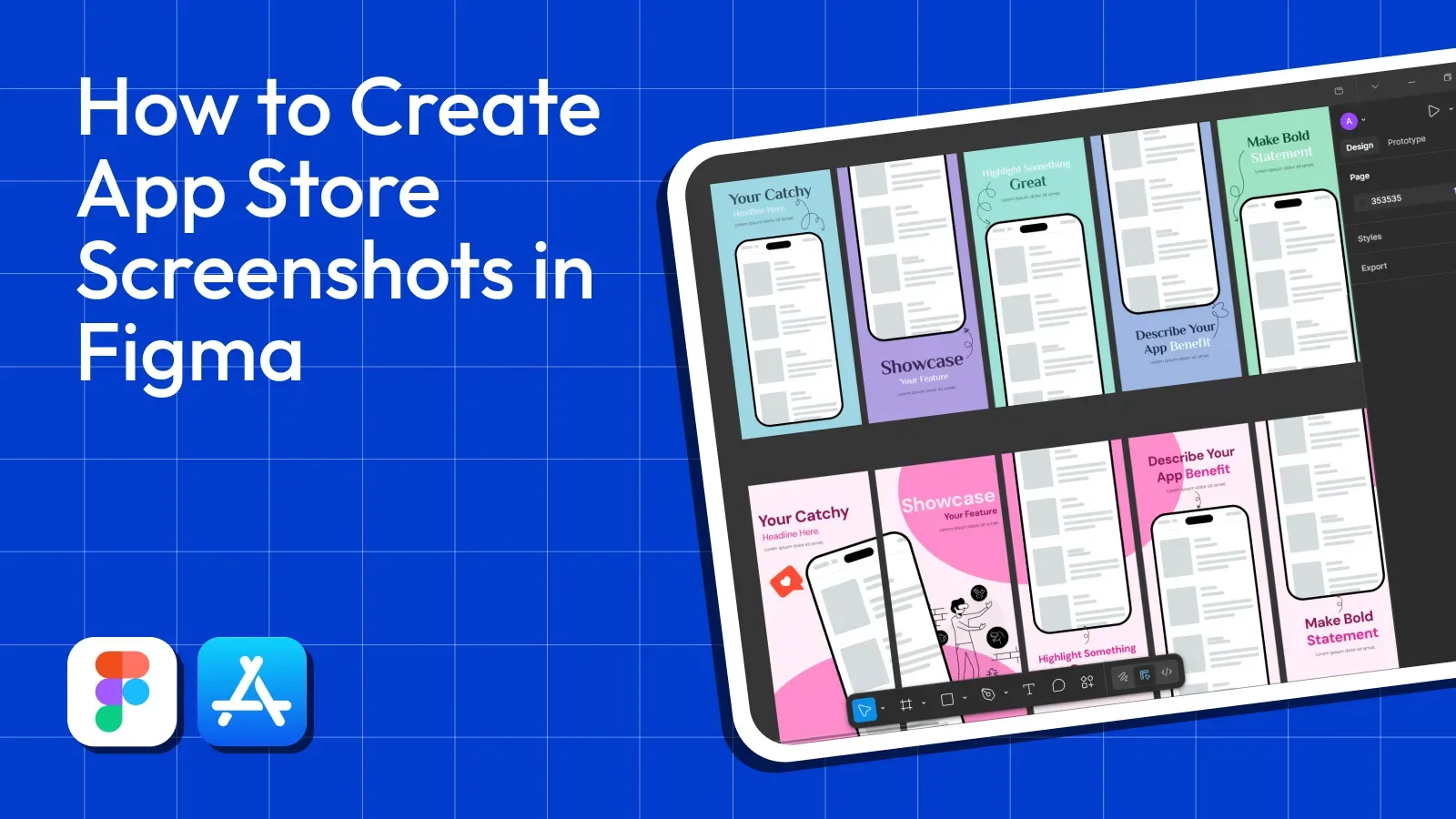
Learn how to create App Store screenshots in Figma using templates, best practices, and expert tips to improve clarity, conversions, and installs

Introduction
If you’ve ever launched an app, you already know this hard truth: App Store screenshots are non-negotiable. Even if you have a great description, 5 Star ratings, and Happy customers, screenshots are often noticed first, which is excellent, but also concerning! You have just a few seconds to make your move. You fail, and users will leave.
Ironically, despite their importance, screenshots are treated as a last-minute task. As a result, you end up publishing screenshots that look like a 3rd grader's art project. This is why Figma has become such a popular tool to create App Store screenshots. You get the result of an expert designer without investing much in heavy design software. In this guide, we will simplify the process of designing App Store screenshots in Figma and explain how a dedicated App Store screenshot tool like AppLaunchpad can help you sail your boat.
What Is Figma
But what’s Figma in the first place? Figma is a web-based design tool that runs directly in the browser. You don’t have to worry about heavy installation or external setup. This is precisely why Figma is so popular. Unlike Photoshop, you can use any device to create app store screenshots in Figma.
Before we get started, here are a few basic terminologies so we are on the same page.
Frames define the size of each screenshot.
Layers control how app screens, text, and backgrounds stack visually.
Components let you reuse layouts and styles across multiple images.
Remember: Figma won’t guide you. Expect no help on how to create compelling visuals or basic structure hierarchy. Knowing what makes a good App Store screenshot comes from experience and screenshot best practices.
Create App Store Screenshots in Figma Using Pre-designed Templates (Step-by-Step)
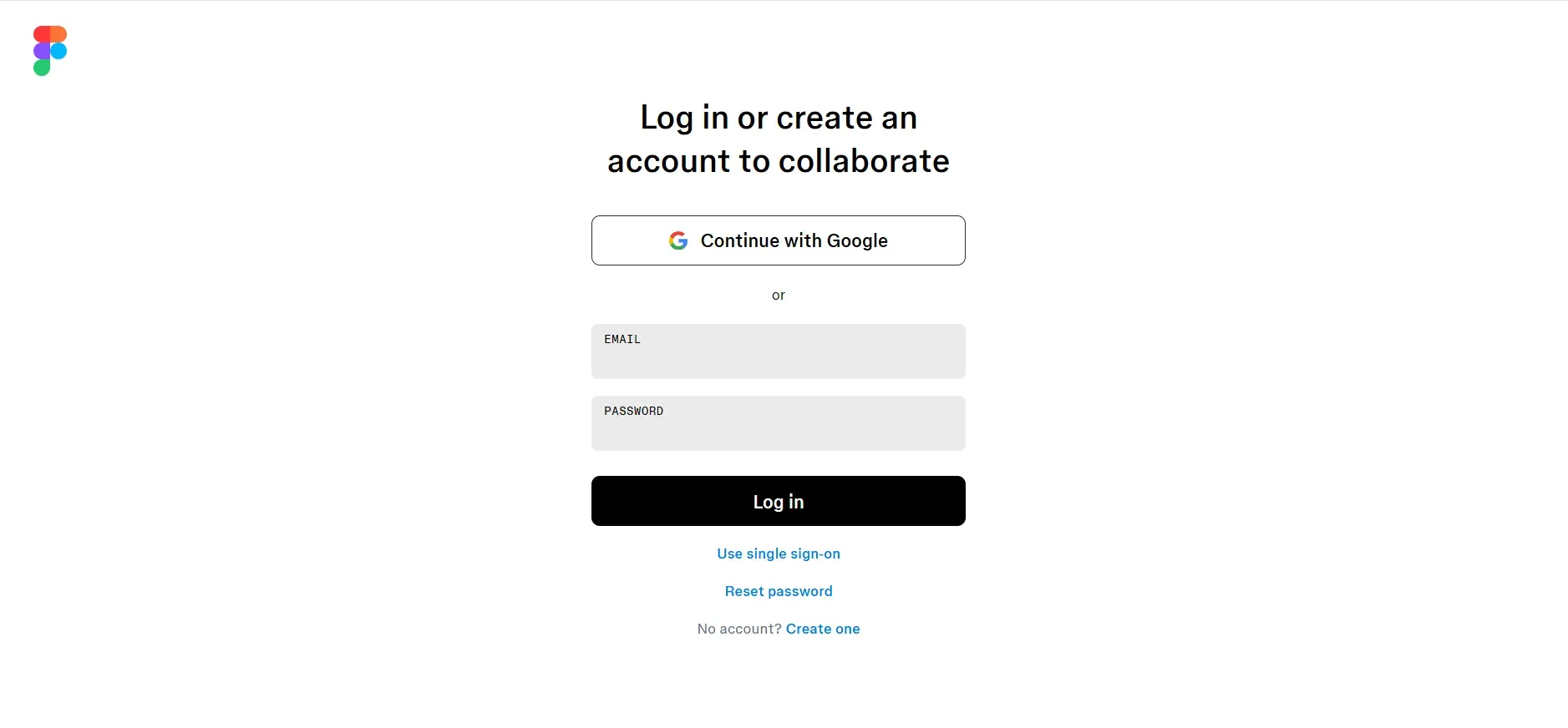
Step 1: Create or Log in to Figma. Create an account on Figma using Google or email. If you already have an account, log in with your existing credentials. If you’re new, the free plan is enough for creating App Store screenshots in Figma.
Step 2: Search for a template. Open the Figma Community and search for terms like “App Store screenshot template” or “iOS app screenshots.” Choose a template that looks clean, uses the latest iPhone frames, and includes multiple screenshot layouts.
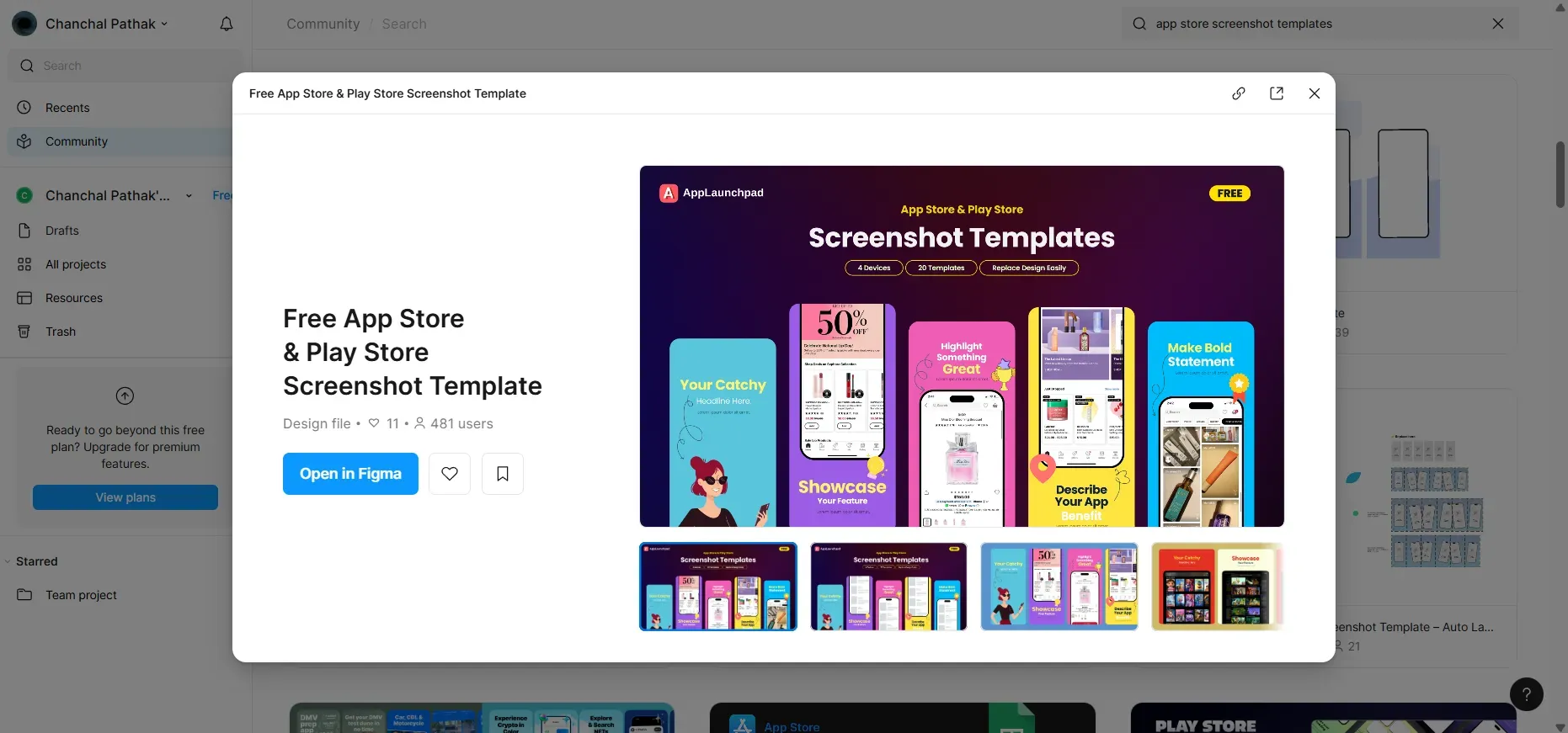
Step 3: Open the template in Figma. Click Open in Figma to open the app store screenshot template in your Figma file.
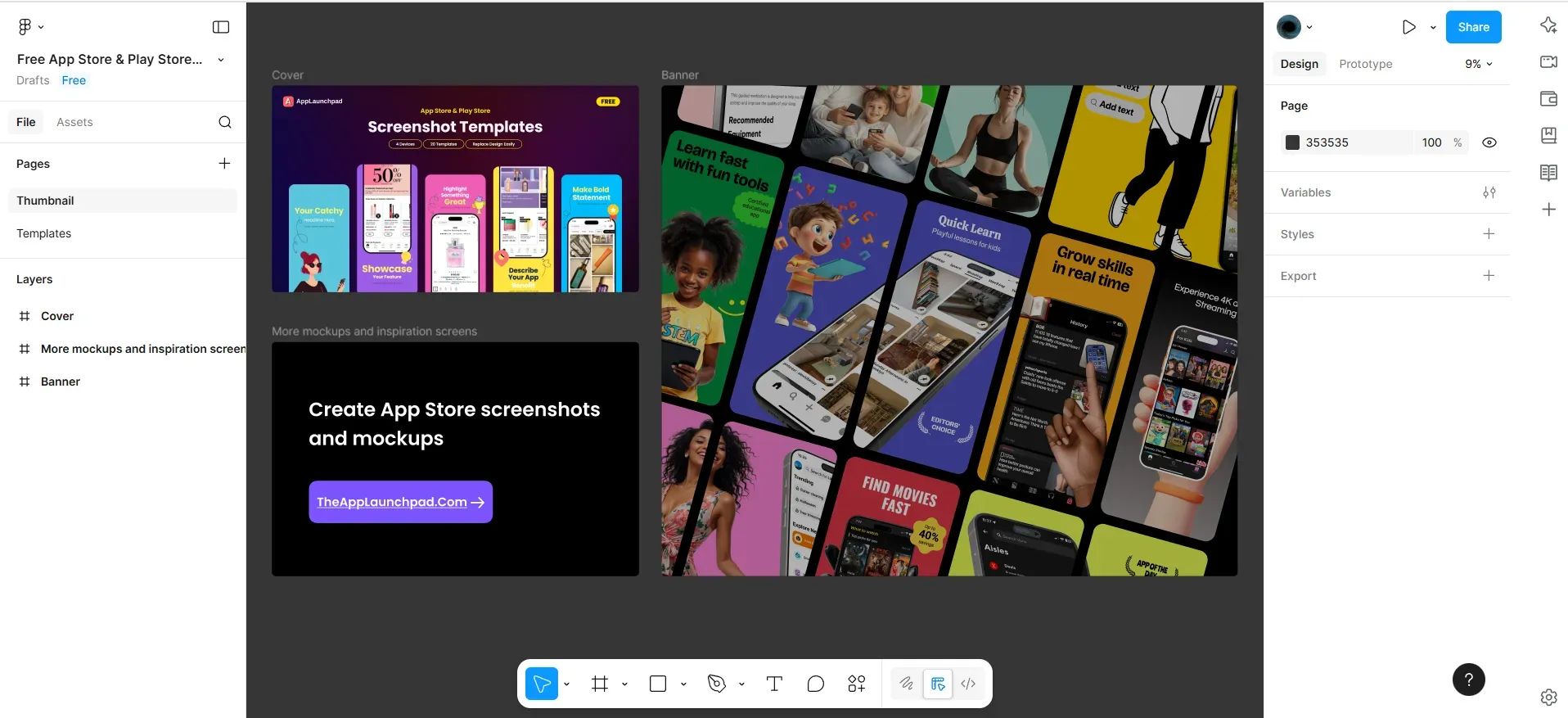
Step 4: Navigate to Pages. Click on the Templates page, which is where you will find editable App store screenshot templates
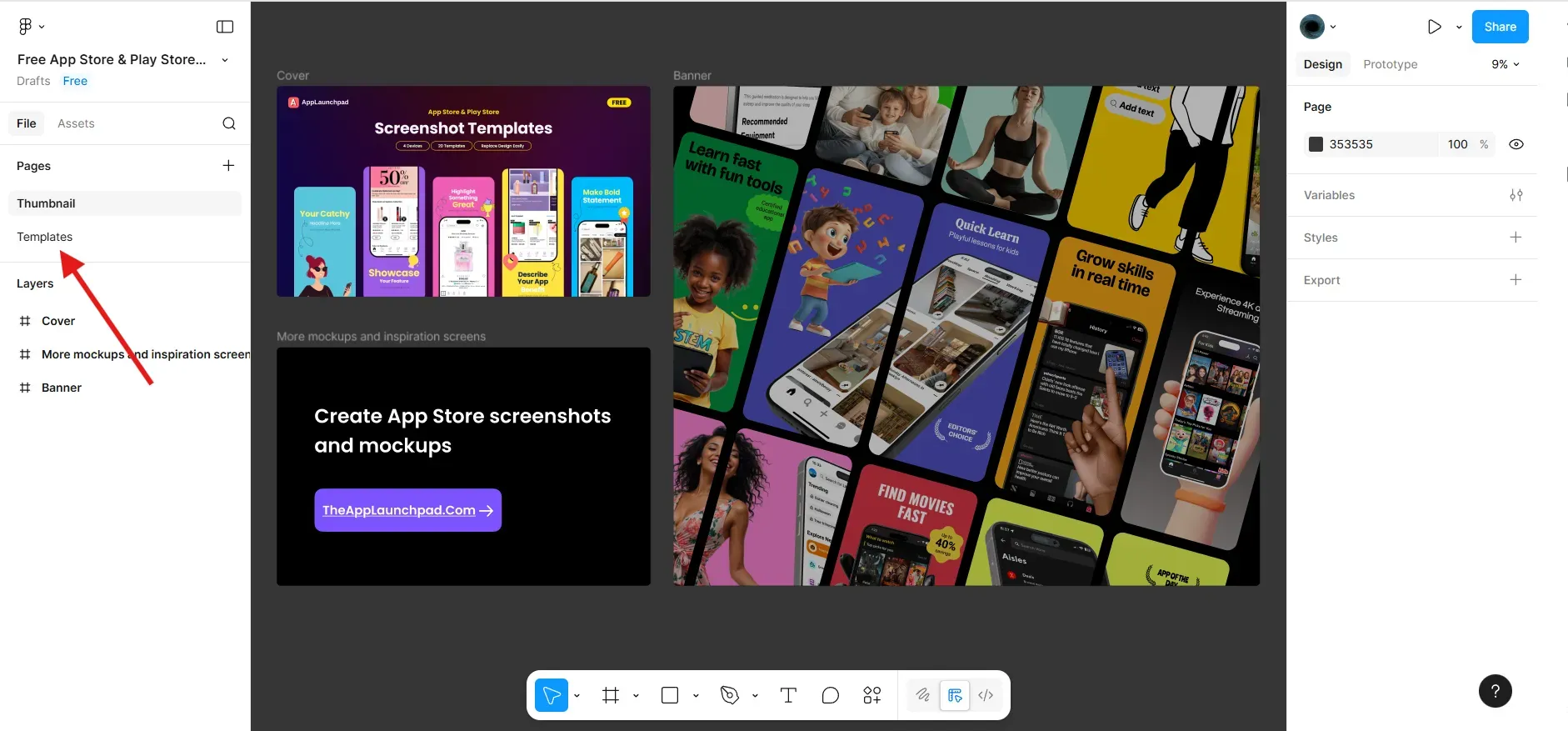
Step 5: Navigate to Layers. Under the Layers section, you will see components such as onboarding, banner, screenshots, and templates. Click on Screenshots.
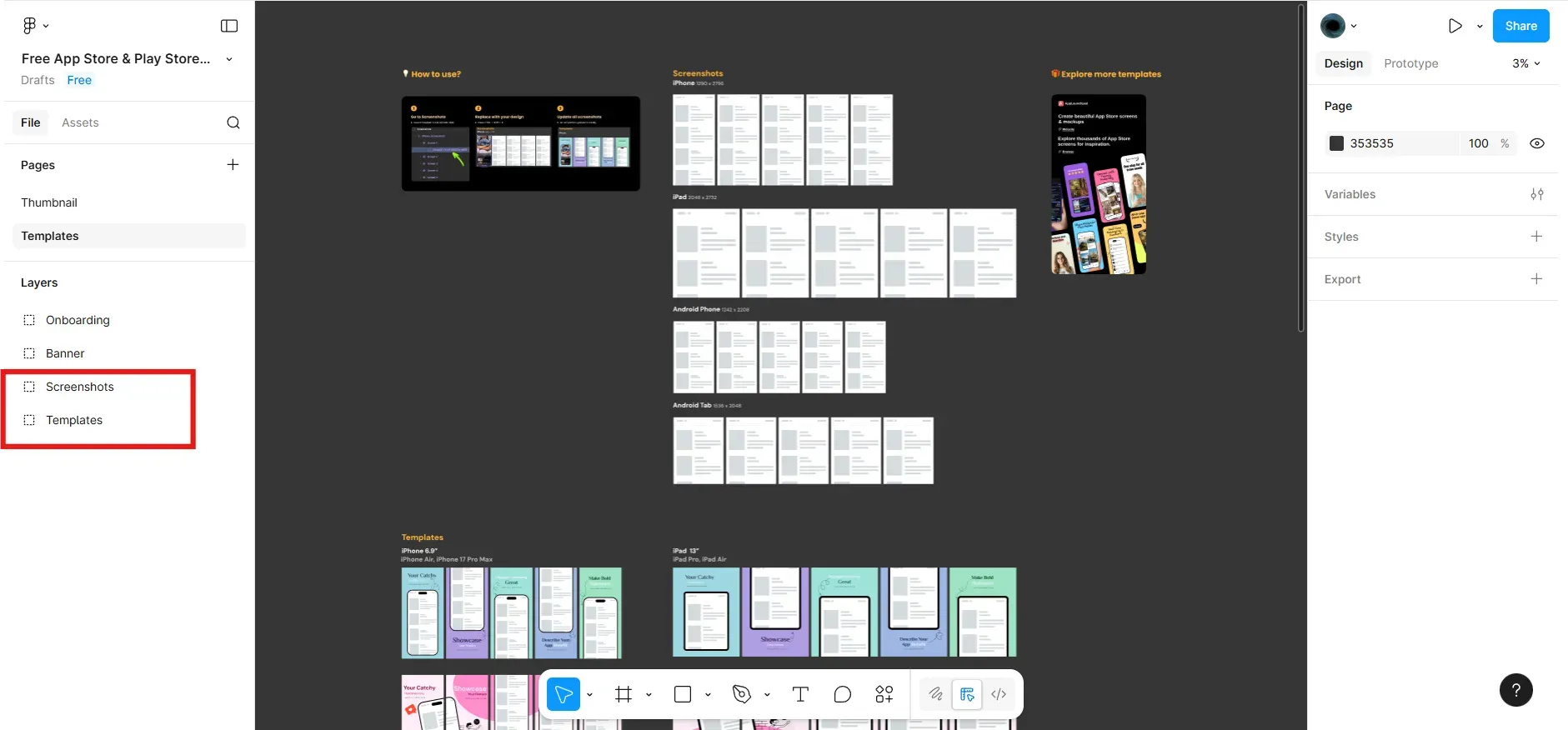
Step 6: Add app screens. Click on Screenshots. You will see multiple devices, such as an iPhone, iPad, etc. Select iPhone, then select Screen 1, and click Change your design here.
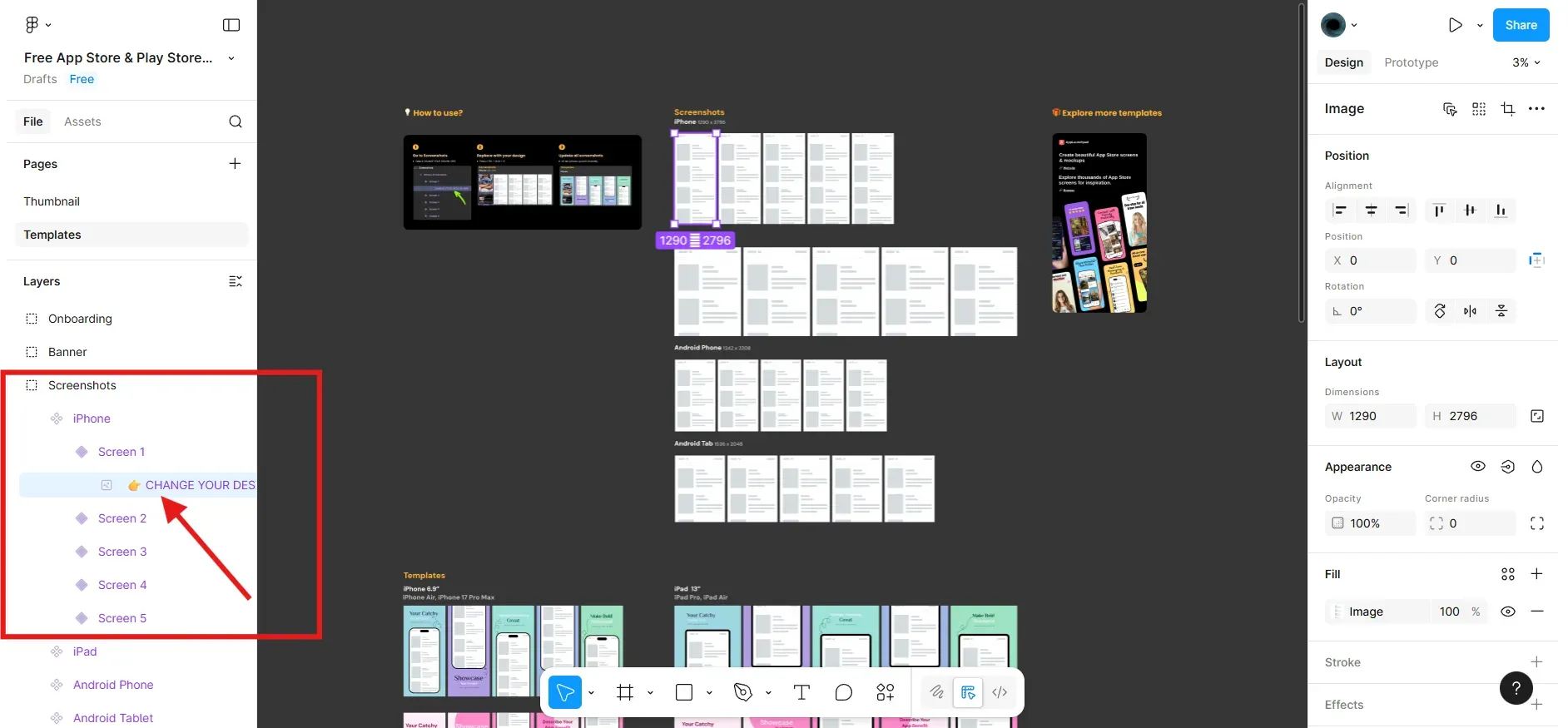
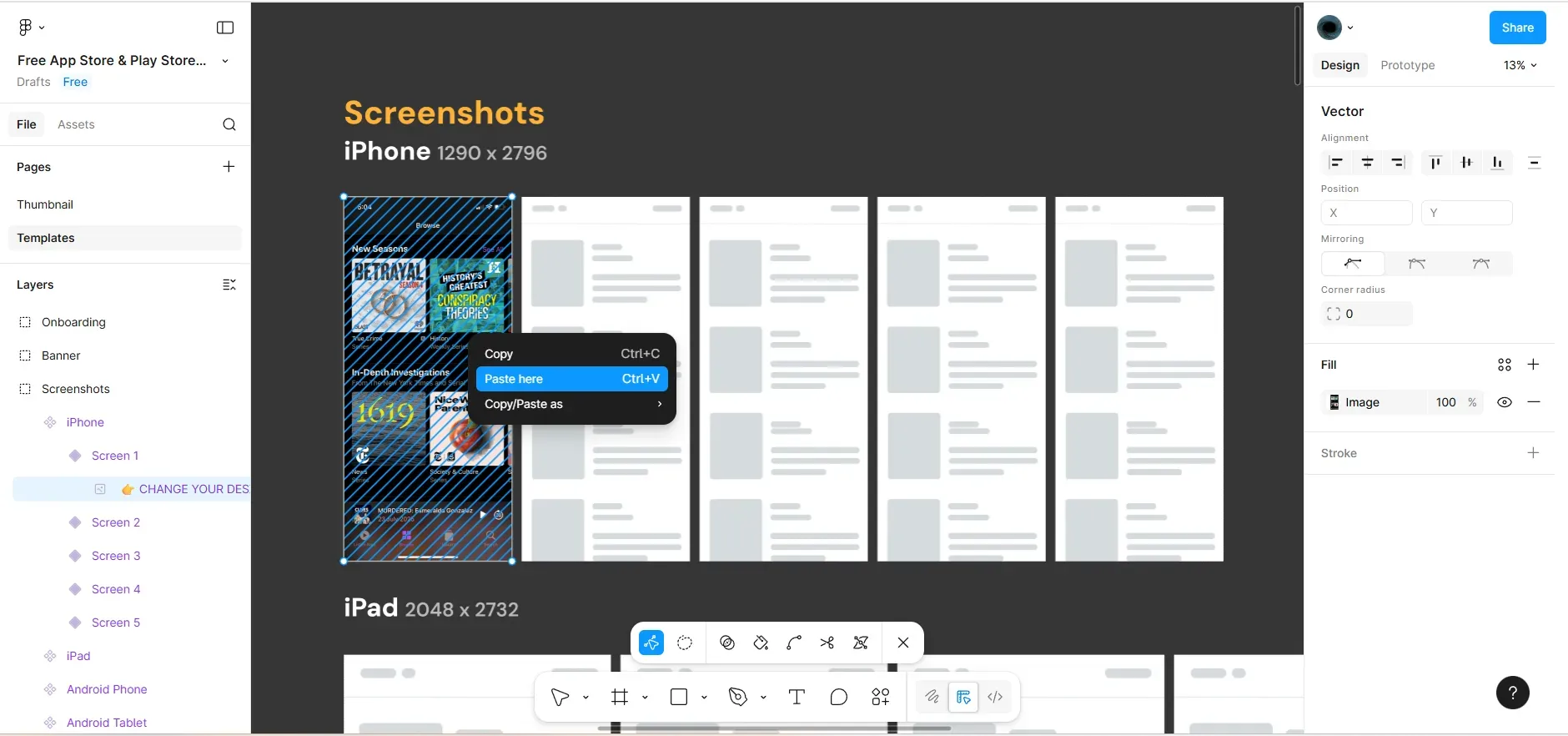
This will select the first placeholder screenshot in iPhone screenshots. Copy your app screen and paste it over the selected screen 1.
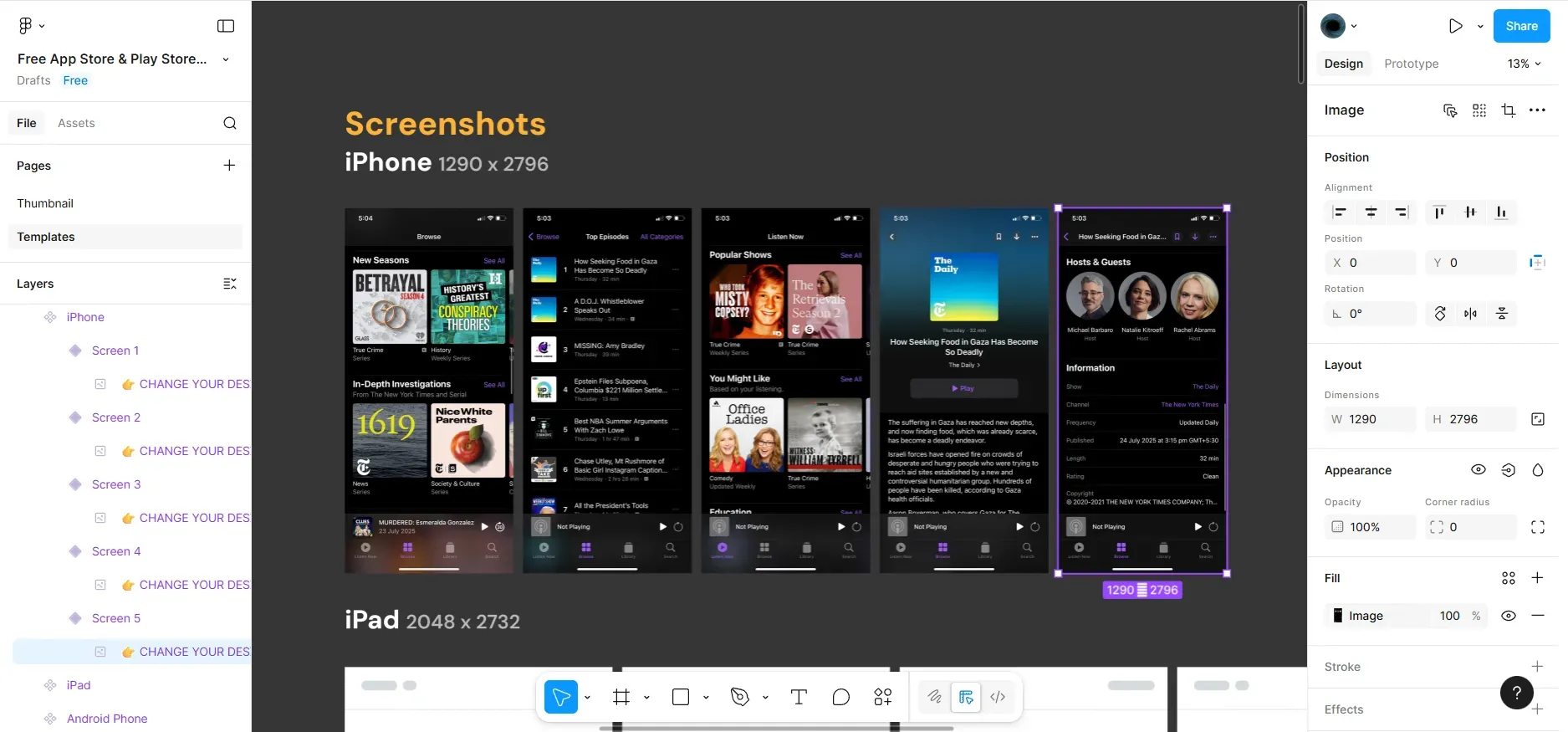
Repeat this process for all five screens.
Step 7: Select a template to edit. After you are done adding your screens, click on Templates, select iPhone.
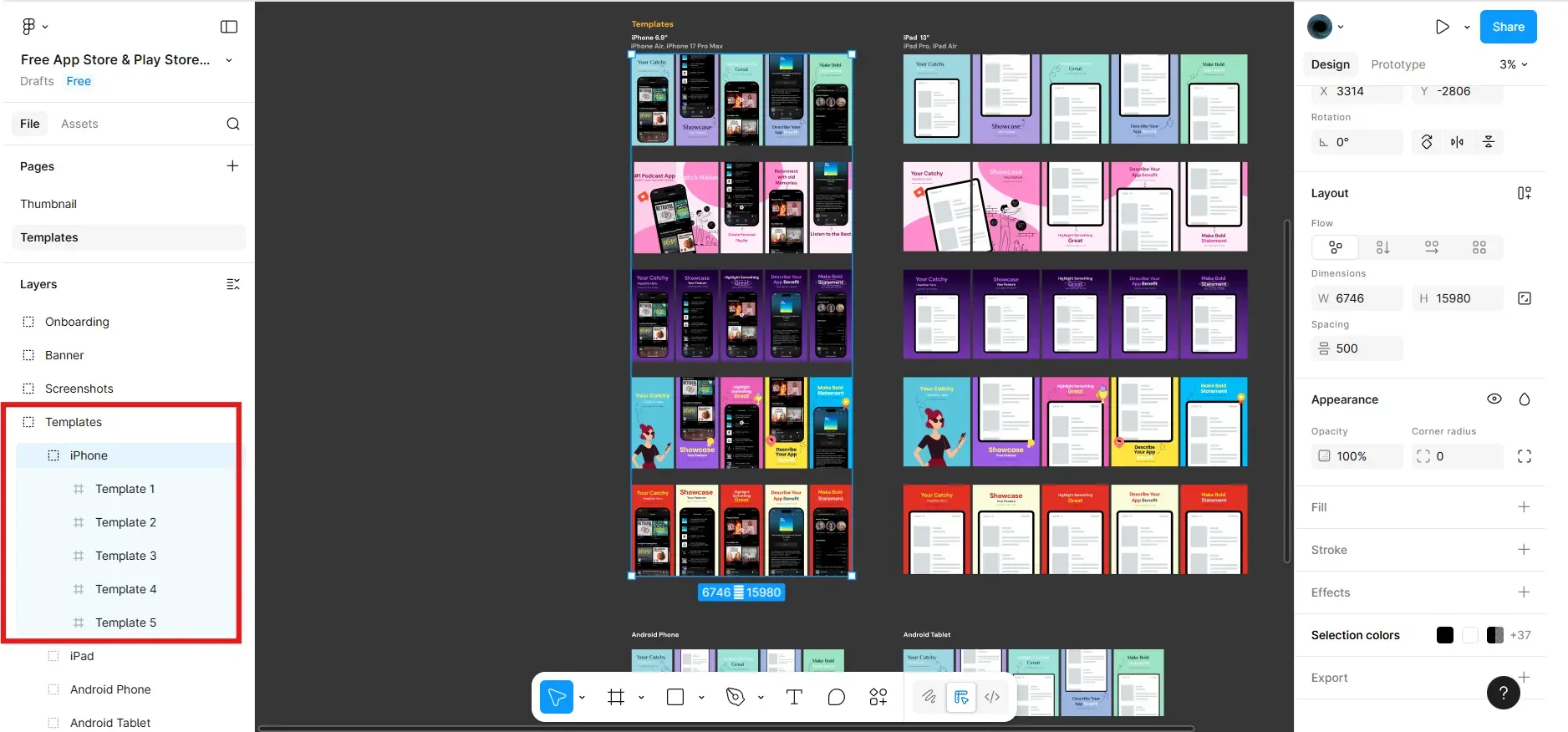
You will notice all iPhone templates have been updated with the app screens you added. Select a template of your choice. All templates are marked as template 1 to template 5.
Step 8: Customize text captions. Select the template you wish to edit. In our case, select template 2. You will see multiple Frames(Frame 1 to 5). These frames represent one set of iPhone screenshots.
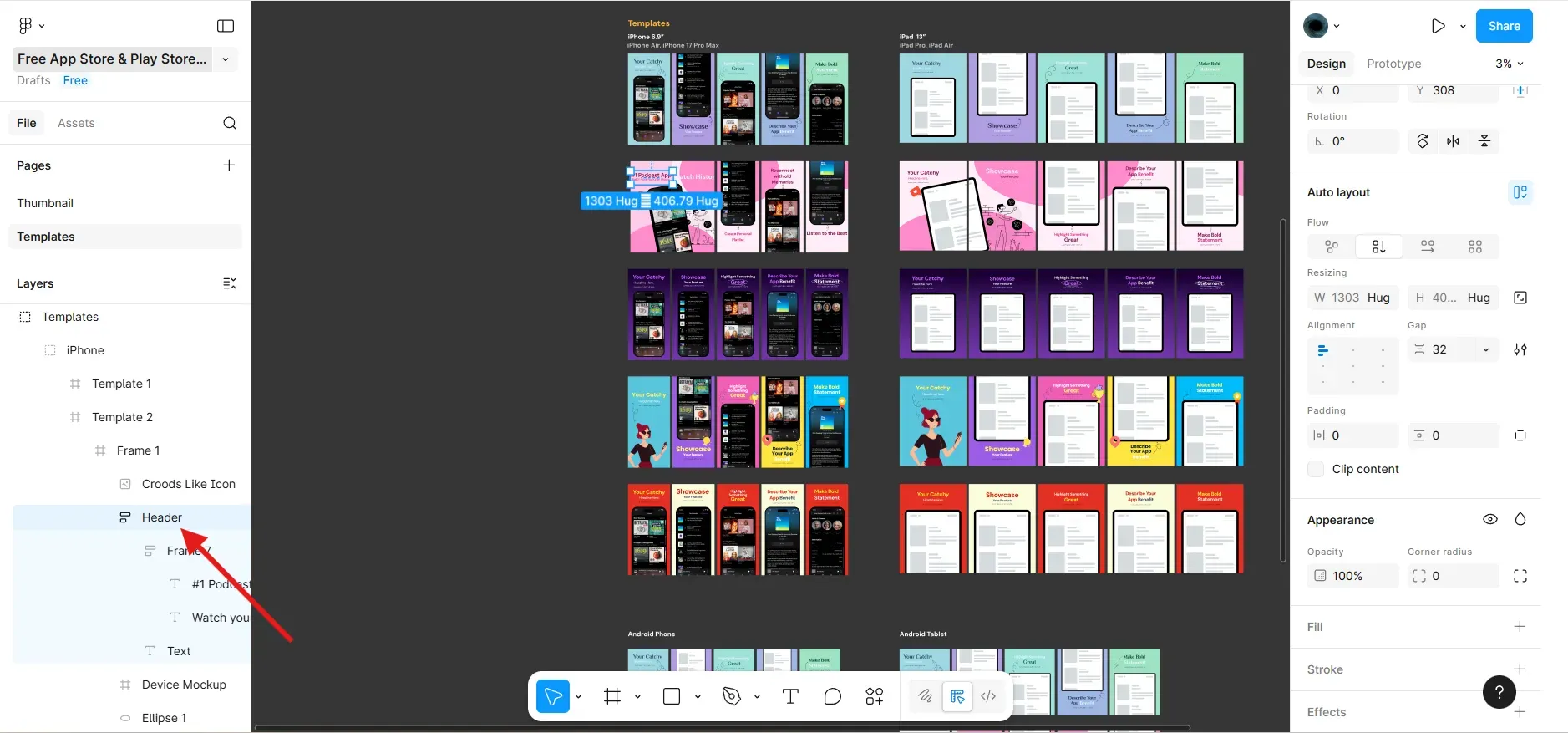
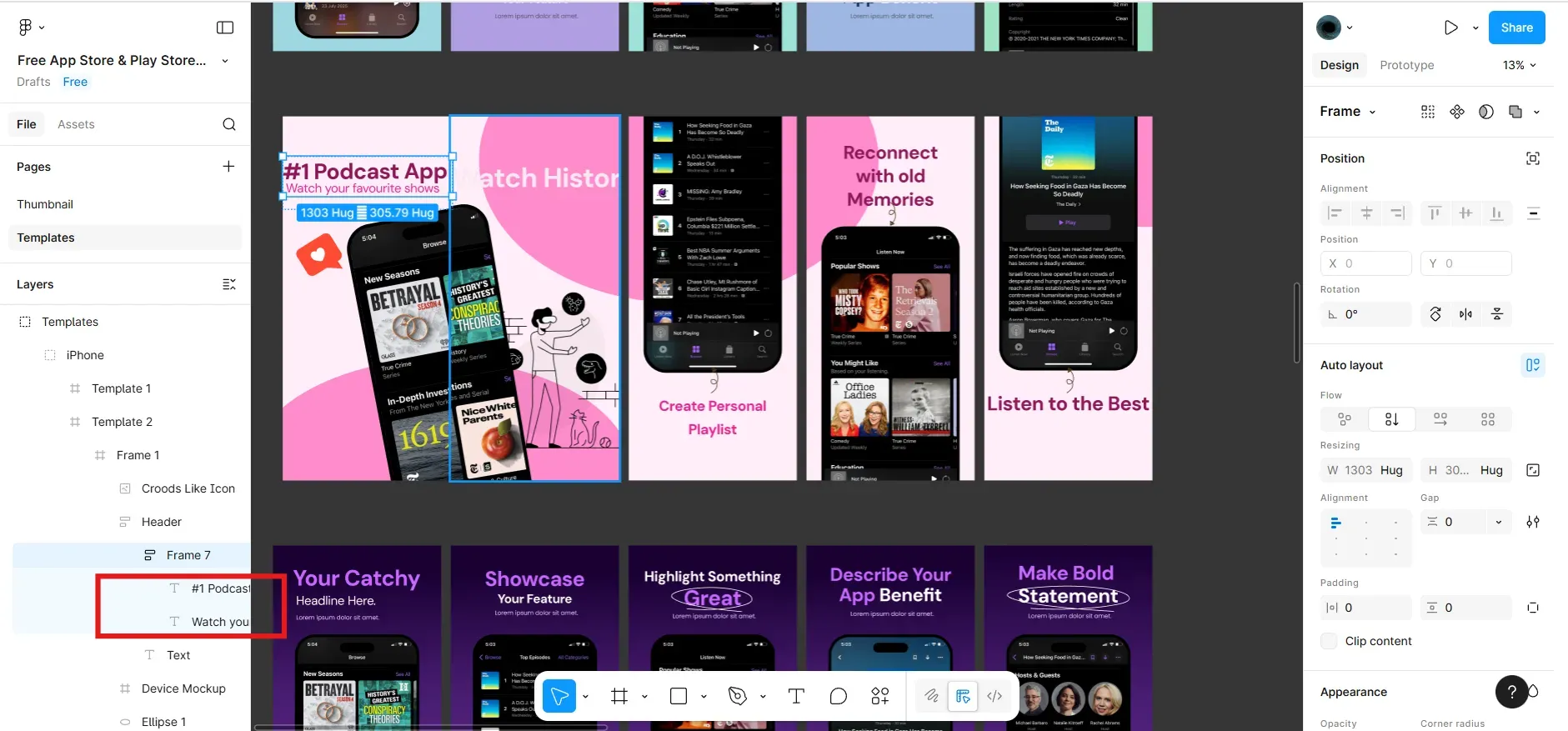
Select Frame 1, click on Header, double-click, and start editing the text caption. Repeat this process for all Frames.
Step 9: Customize the background color. To change the background color, click Frame 1. Look for the Fill option in the right-side panel and choose a color of your choice.
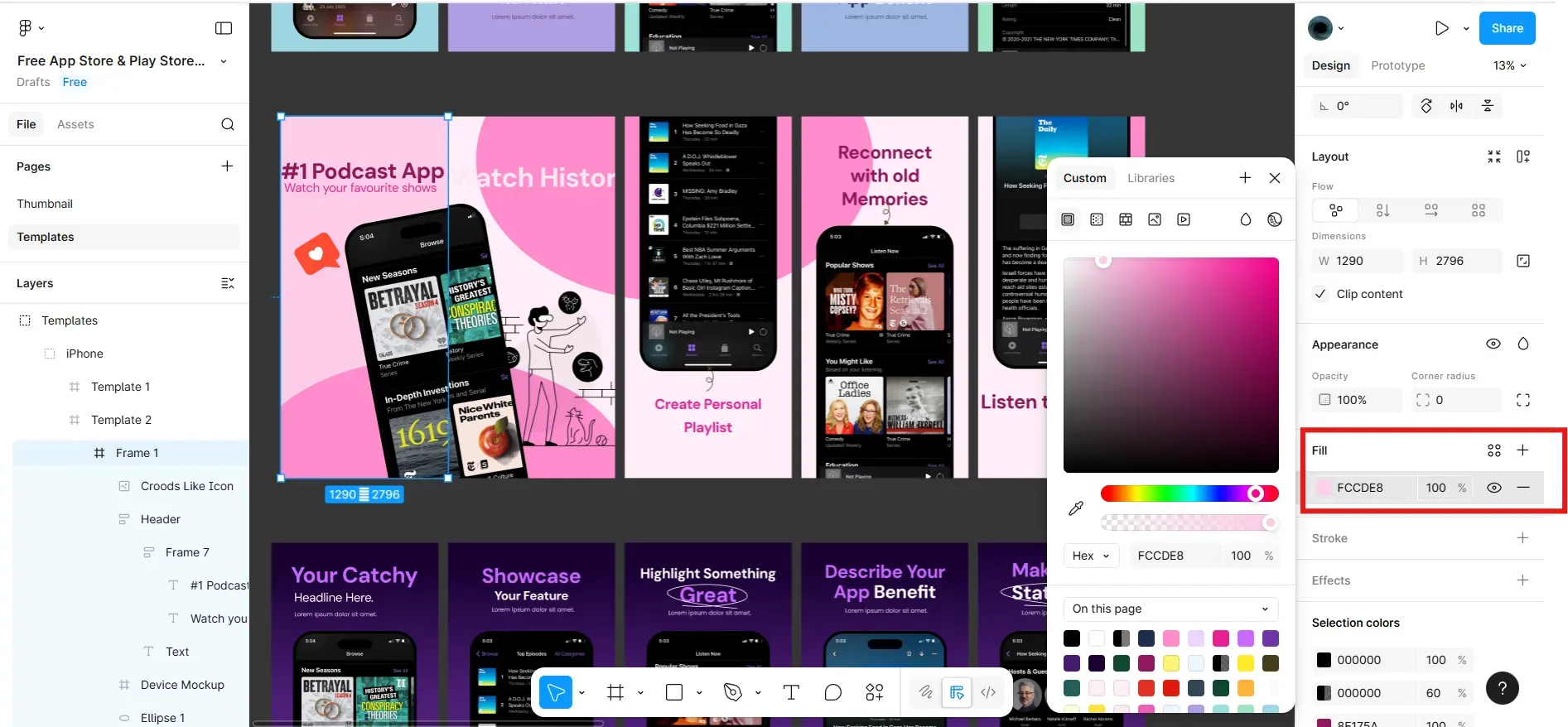
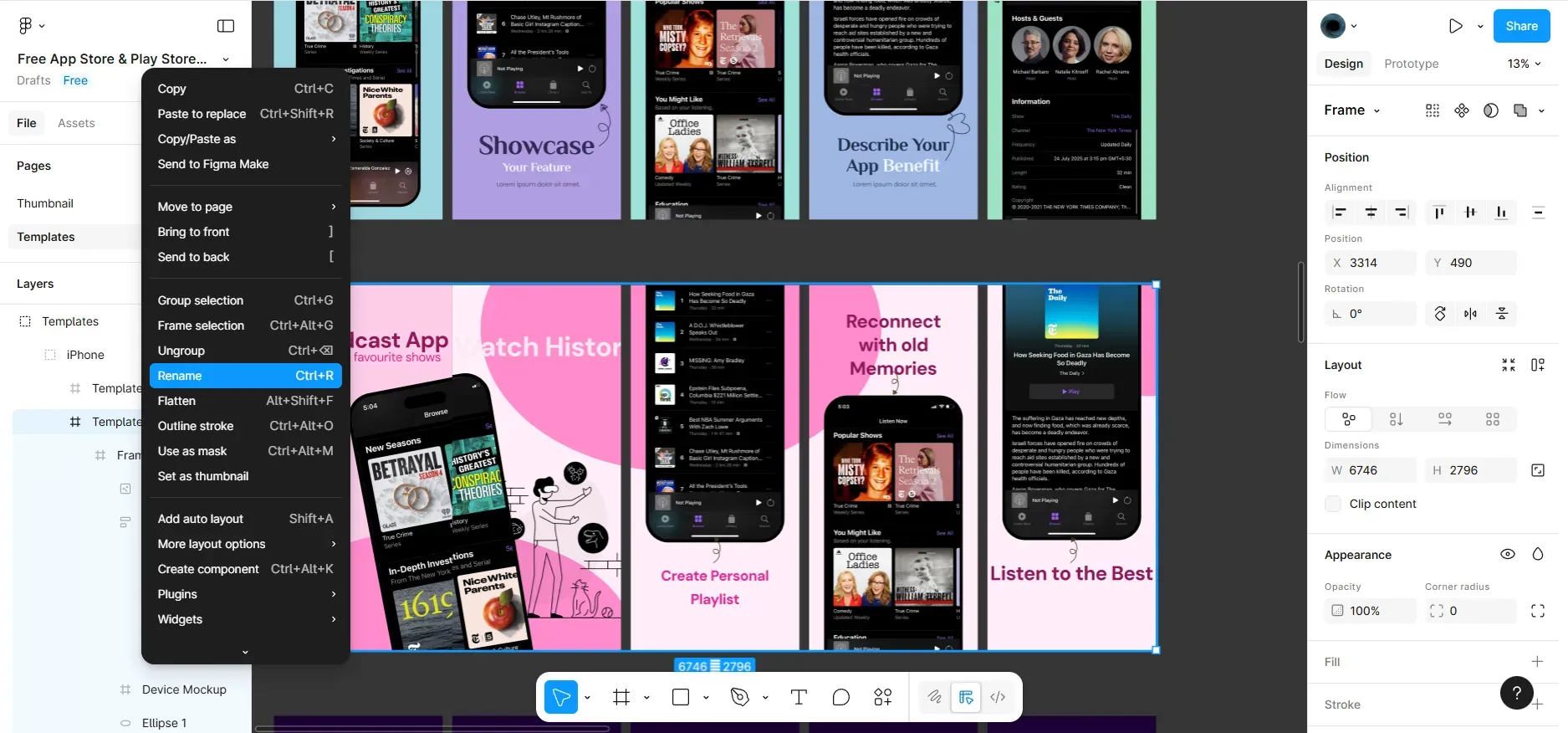
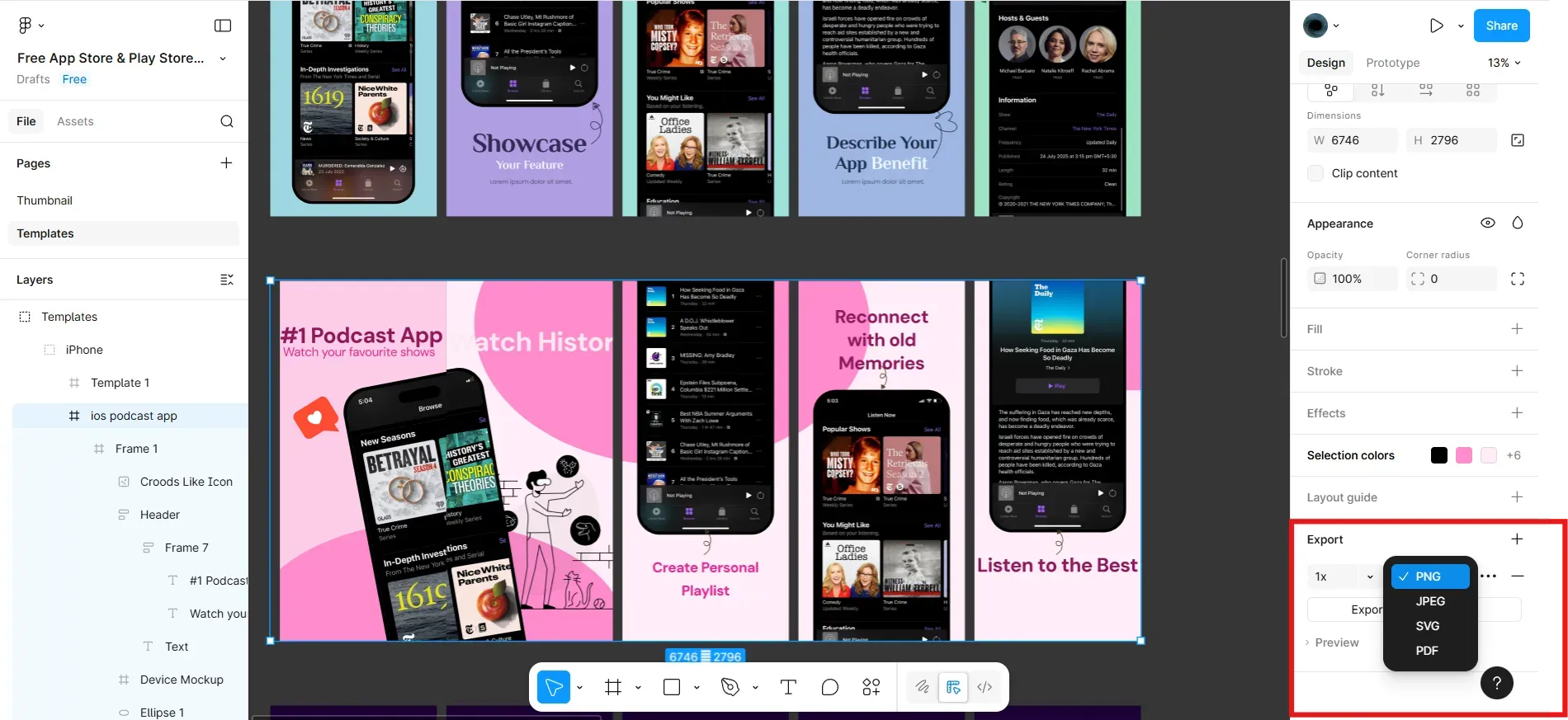
Zoom out and check consistency across all frames. Make sure spacing, colors, and tone are uniform and well-aligned. Step 10: Export the template. Select the entire template, rename it to an appropriate name, and export it as a PNG or JPG. These files are now ready to upload to App Store Connect.
When Figma Works Best for App Store Screenshots
Figma works best when you want complete creative control. If you care more about how your app store screenshots will turn out, regardless of how much time it will take, Figma is a solid choice. Developers who are comfortable tweaking text captions, colors, and spacing usually feel at home here.
It’s handy when you’re:
Preparing app store screenshots for a new app launch
Matching screenshots closely to the in-app design
Collaborating with designers or marketers
Where Figma gives you some trouble is scale. Using Figma for frequent updates, design experiments, or localizing app store screenshots requires a lot of manual work. At which point, you realise the importance of speed and automation.
Why Figma Isn’t Enough Sometimes
Figma is indeed powerful and highly flexible, but that flexibility comes with trade-offs. For many app developers and small startups, Figma starts to show limitations when app store screenshots become a regular task. Below are a few pain points of Figma designers.
Takes too much manual work
Creating app store screenshots in Figma involves multiple small and repetitive steps. Every screenshot needs manual customization and final edits, and when you update your app, you often have to go through the same process again and again.
Limited automation for App Store screenshots
Figma doesn’t offer automation features for App Store screenshots. There’s no built-in function to generate multiple app store screenshots in Figma at once or apply changes across different variations. Localizing app store screenshots in Figma is also manual, which slows down the scaling.
Steeper learning curve for non-designers
While Figma is relatively easier than Photoshop and other traditional design tools, it’s still pretty much a design tool. Non-designers and beginners often struggle with basic Figma elements like frames, layers, and constraints. This can create significant pressure, especially if you are shipping an app for the first time.
Beginners often run into:
Confusion between basic concepts like frames and groups
Accidental layout mishap while editing
Not knowing if they are doing it right
No built-in App Store optimization guidance
Figma doesn’t tell you how to optimize screenshots for conversions. It won’t suggest headline length, screenshot order, or visual hierarchy based on App Store screenshots best practices. You rely on your own knowledge and experience. You may find yourself asking an AI agent how to create app store screenshots in Figma.
Hard to scale screenshots for multiple updates
As your app grows, screenshots need to be updated, too. In Figma, each update will require you to revisit every frame and navigate an endless list of editing options. Managing multiple screenshot variants, experiments, or releases can become messy in no time.
Creating app store screenshots in Figma becomes a big headache when:
You ship frequent feature updates
You run A/B tests on screenshot copy
You maintain multiple app versions
Not designed explicitly for App Store screenshots
Remember what I said earlier, Figma is a general-purpose design platform. Which means you can design anything and everything on Figma. App Store screenshots in Figma are a much smaller use case. As a result, Figma workflows are not optimized for speed or repetitive tasks. The result:
More flexibility than actually needed
More decisions to make every time
More room for inconsistency and errors
In simple words, Figma works well for control and customization, but it lacks speed, automation, and scale. If you need to make frequent screenshot updates or you are a complete design rookie, don’t ignore these red flags.
A Better Alternative for App Store Screenshots: AppLaunchpad
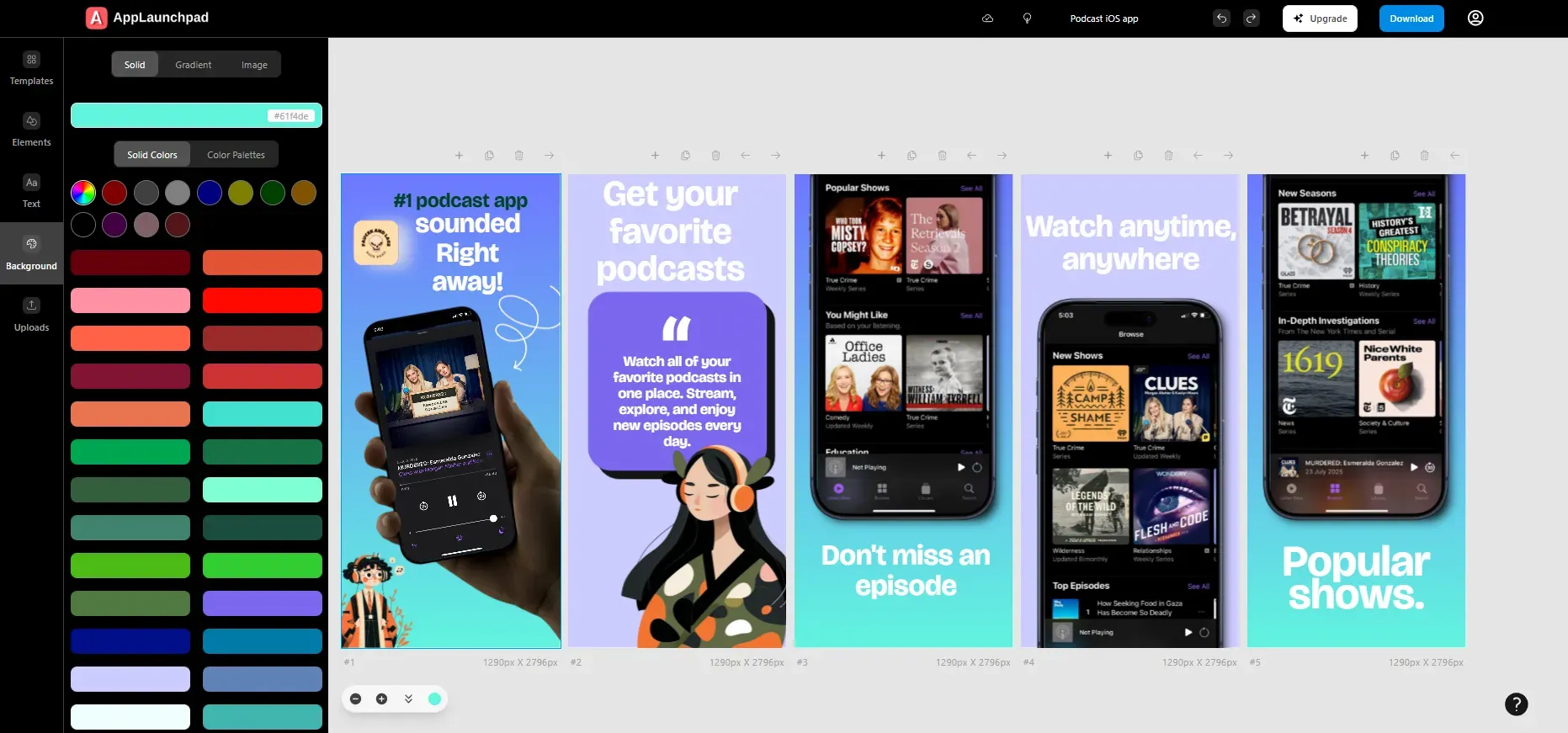
While Figma is a great design tool, sometimes you need a tool built specifically for App Store screenshots. This is where AppLaunchpad helps you. AppLaunchpad is one of the best app store screenshot generators. Instead of starting from a blank canvas on Figma, you get ready-made templates that are already optimized for the App Store screenshot guidelines.
AppLaunchpad works on a simple philosophy:
You pick a template
upload app screens
Customize your template
and click download, all without using a single design skill.
For teams that update screenshots often or want consistent, high-quality visuals with minimal effort, AppLaunchpad can save significant time compared to Figma. It’s a solid alternative for anyone who doesn’t know much about design but wishes their app store screenshots could look as good as those generated by designers.
Why Choose AppLaunchpad Over Figma
Built specifically for App Store screenshots
AppLaunchpad is designed for creating App Store screenshots. Unlike Figma, which serves many design use cases, AppLaunchpad focuses entirely on app store visuals including App icons for App Store. This specialization removes confusion and guesswork around layout, spacing, and device sizing. You don’t need to decide how the screenshots should look; AppLaunchpad already follows App Store best practices.
Faster results with less manual work
Speed is where AppLaunchpad outperforms Figma. In Figma, you manually place screens, align text, and repeat the same steps again and again. AppLaunchpad simplifies this process. You upload your app screens, choose a template, and start editing immediately. What usually takes hours in Figma can be done in minutes here.
No design skills required
Whether you are a designer, marketer, or Startup founder, AppLaunchpad has got you covered. You don’t need to understand complex concepts like frames, layers, or constraints. You just need to know textbook editing: change text, swap images, adjust colors, and you are good to go.
App Store-ready templates
The templates in AppLaunchpad are explicitly created for App Store conversion. AppLaunchpad includes App Store-compliant templates that feature a clear visual hierarchy, readable text sizes, and layouts that scale well on mobile screens and desktops. App store screenshot templates in Figma vary in quality and often require manual adjustments.
Easy scaling for updates, launches, and A/B testing
As apps grow, screenshots need frequent updates. AppLaunchpad makes it easier to duplicate projects, test new copy, or prepare screenshots for feature launches. You can create variations quickly without rebuilding everything from scratch. This is especially useful for developers who often run experiments.
Simplified workflow
AppLaunchpad streamlines the entire process from start to finish. You go from app screen to downloadable screenshot in a single flow. Projects are saved automatically, exports are App Store–ready, and there’s less room for mistakes.
Create App Store Screenshots with AppLaunchpad: Step-by-Step Process
Below is a detailed guide on how you can create professional App Store screenshots in AppLaunchpad
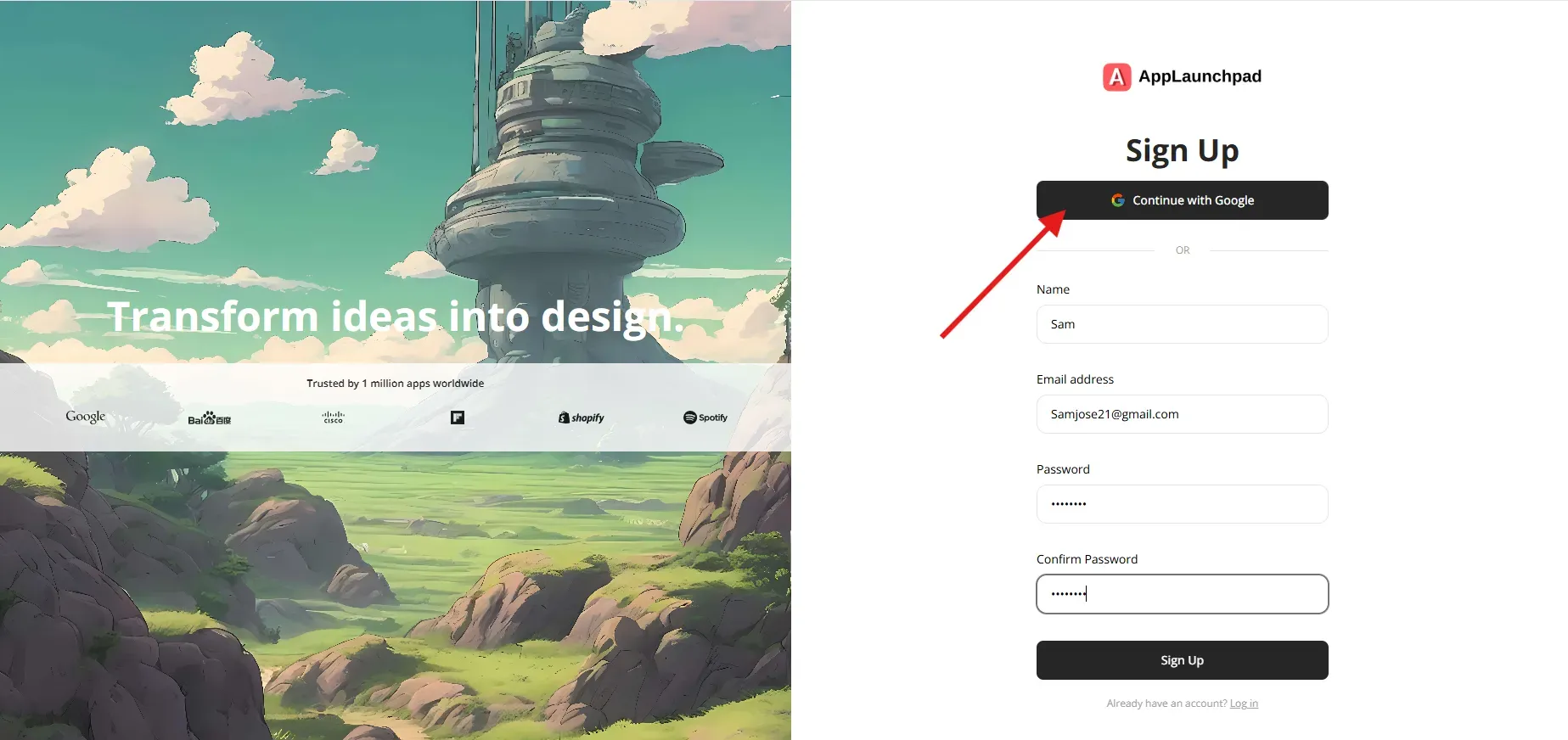
Step 1: Create an account. Visit AppLaunchpad and sign up using Google or email. If you already have an account, log in with your saved credentials.
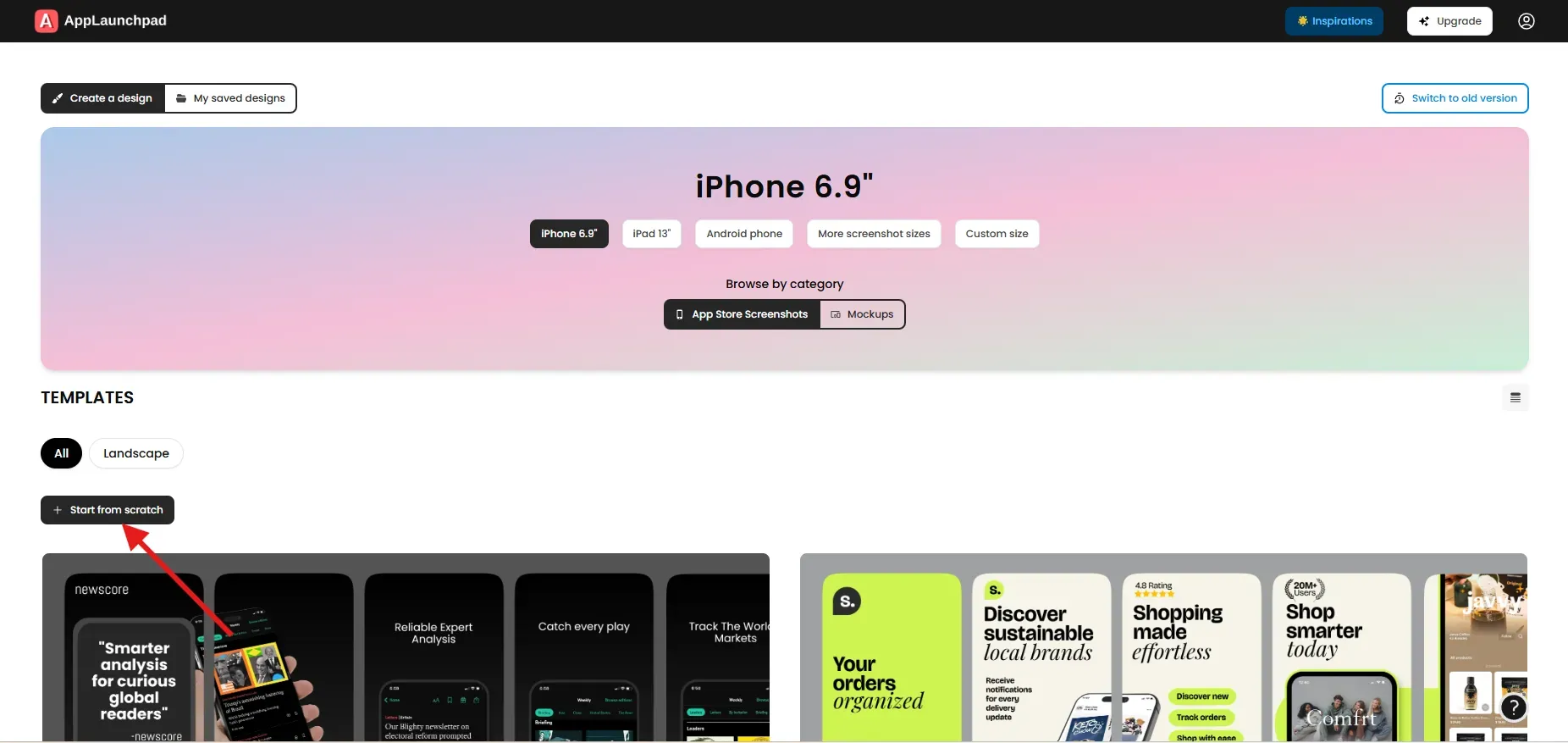
Step 2: Choose how you want to create screenshots. Once inside the dashboard, you’ll see two options: Start from scratch or Use pre-designed templates. For most developers, templates are much faster. They reduce manual work and already follow App Store-compliant layouts, which is what we will focus on.
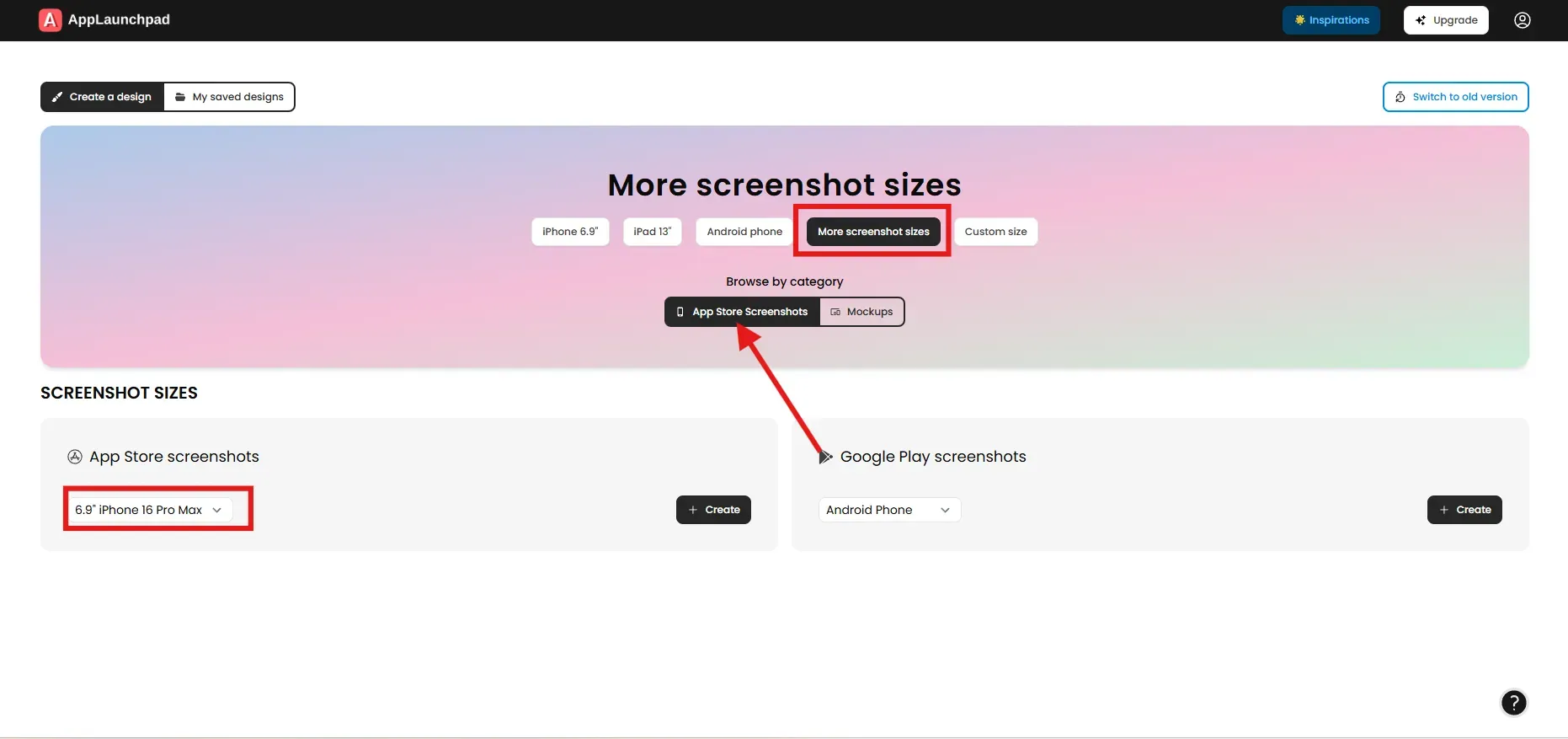
Step 3: Choose an iPhone or iPad device (For Google Play Store screenshots pick an Android device). AppLaunchpad supports the latest iPhone models by default, and if you want older device models, you can easily select them using the More screenshot sizes option.
Step 4: Select a template. Once you have selected a device, browse templates and choose one that matches your app’s category or style. If you’re using a free plan, look for templates with a free label. If you want premium templates, consider upgrading to the Pro plan.
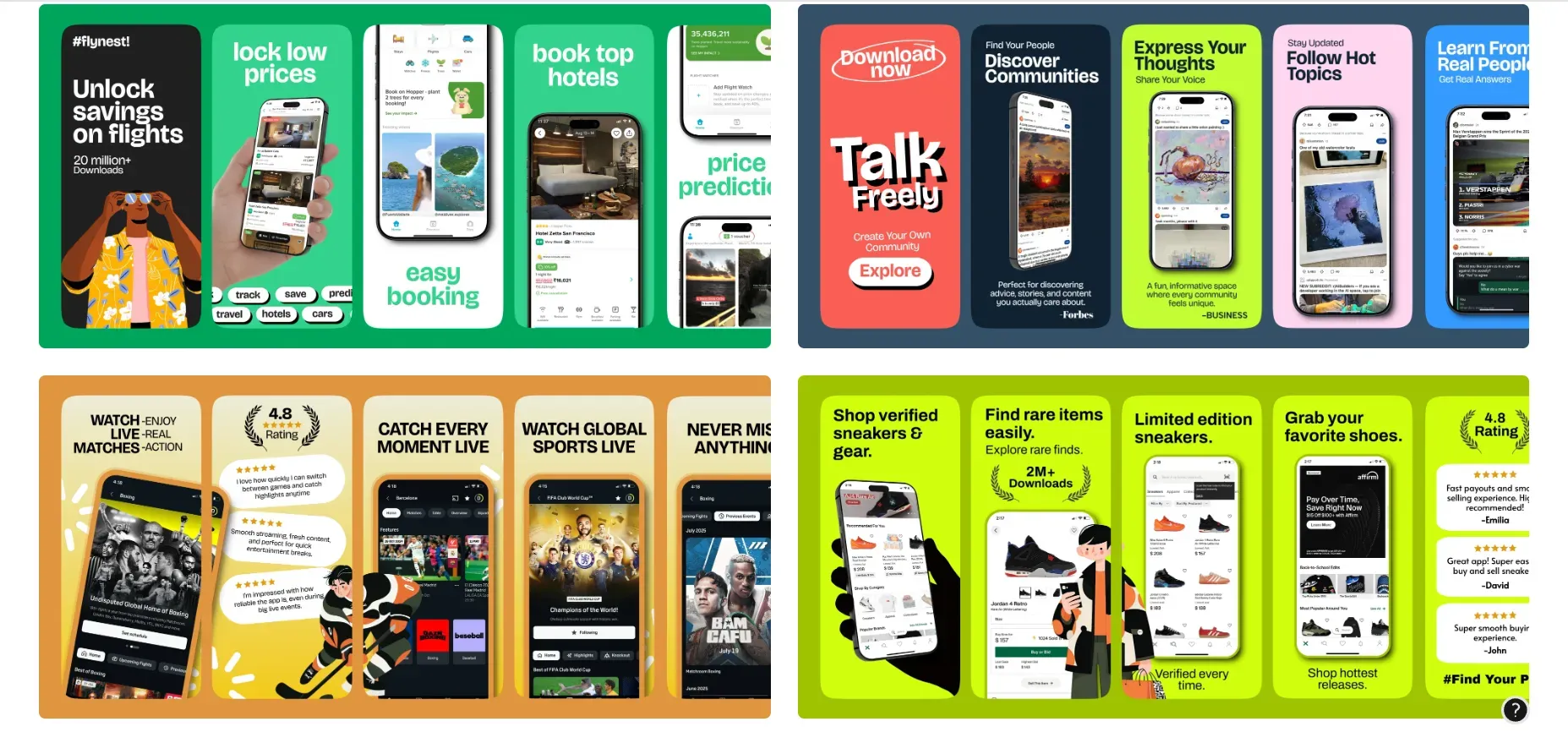
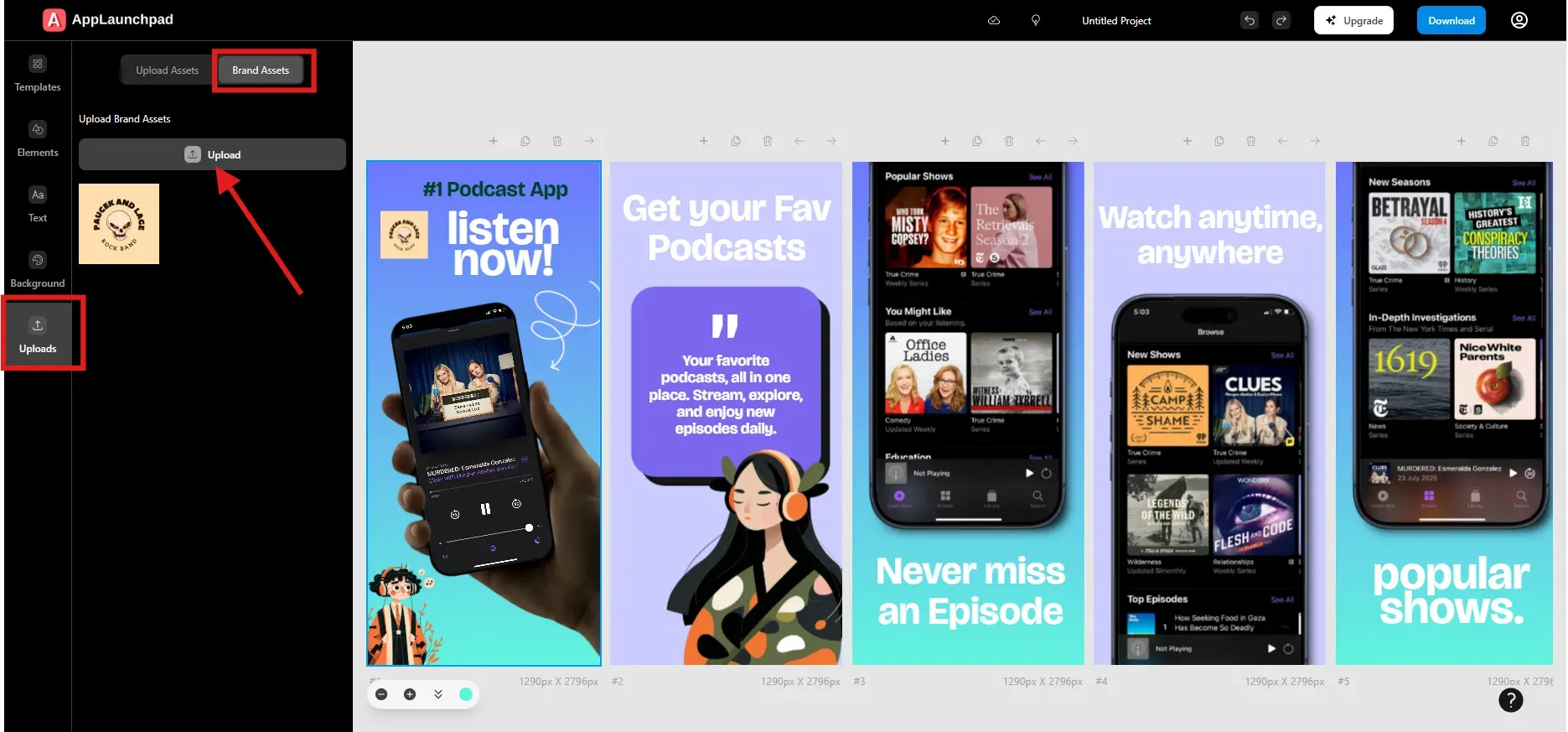
Step 5: Upload your app screens. Once inside the editor, start customizing the selected template. Upload your app screens under the Uploads tab and place them into each screenshot frame.
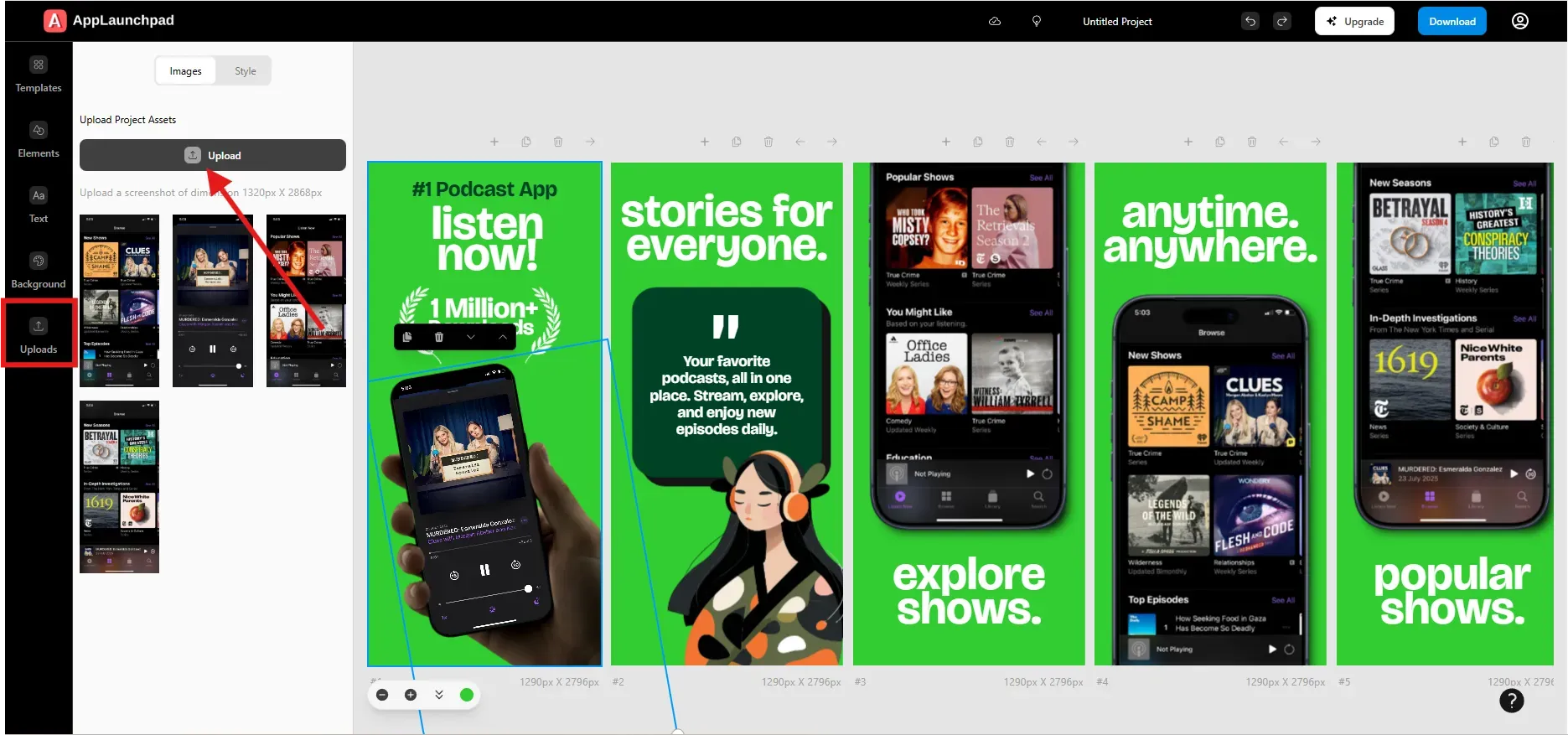
Step 6: Add, remove, or edit text inside the template under the Text tab. Customize font size, alignment, and spacing for better readability.
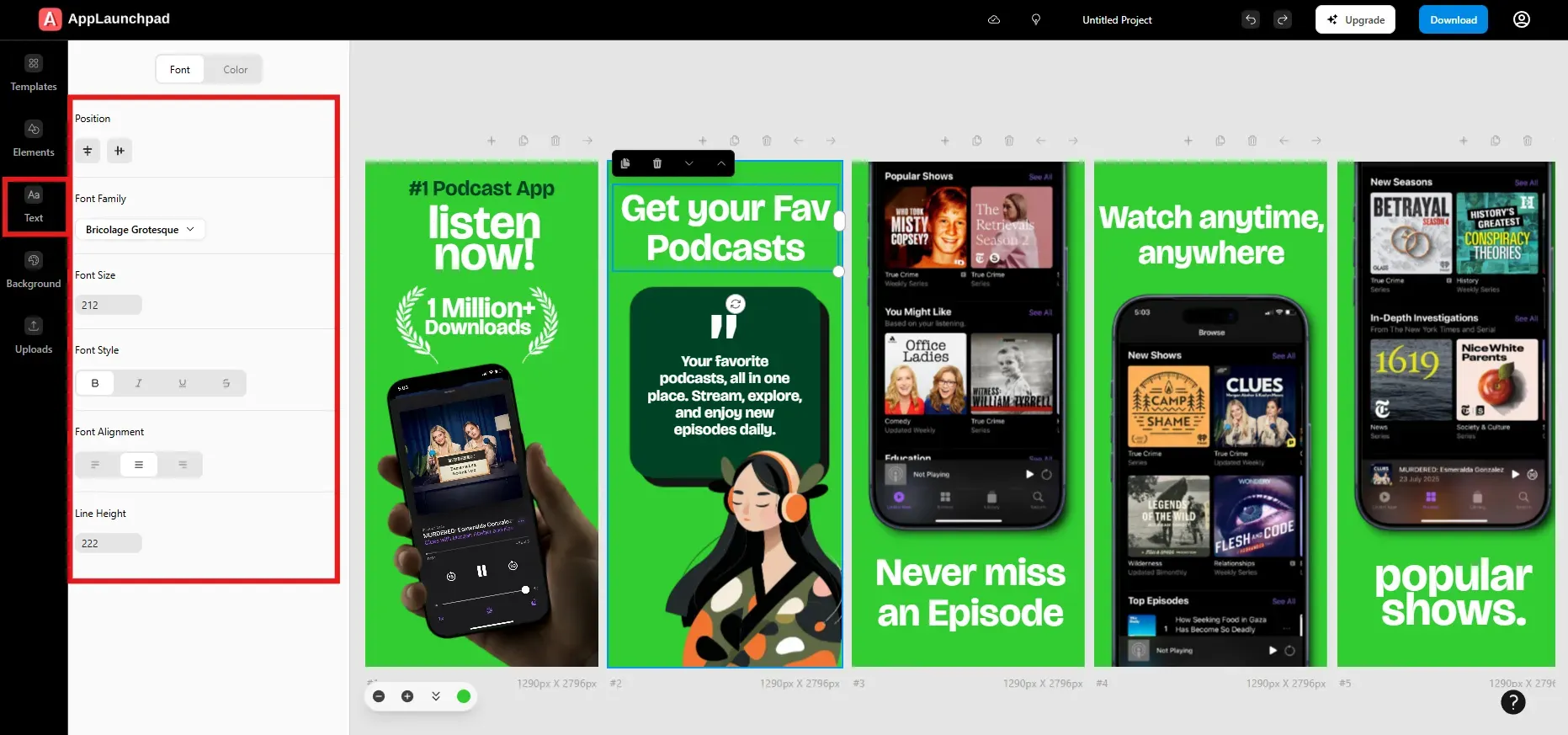
Step 7: Apply background customization if needed. Click on the Background tab and choose a background color, gradient, or upload a background image.
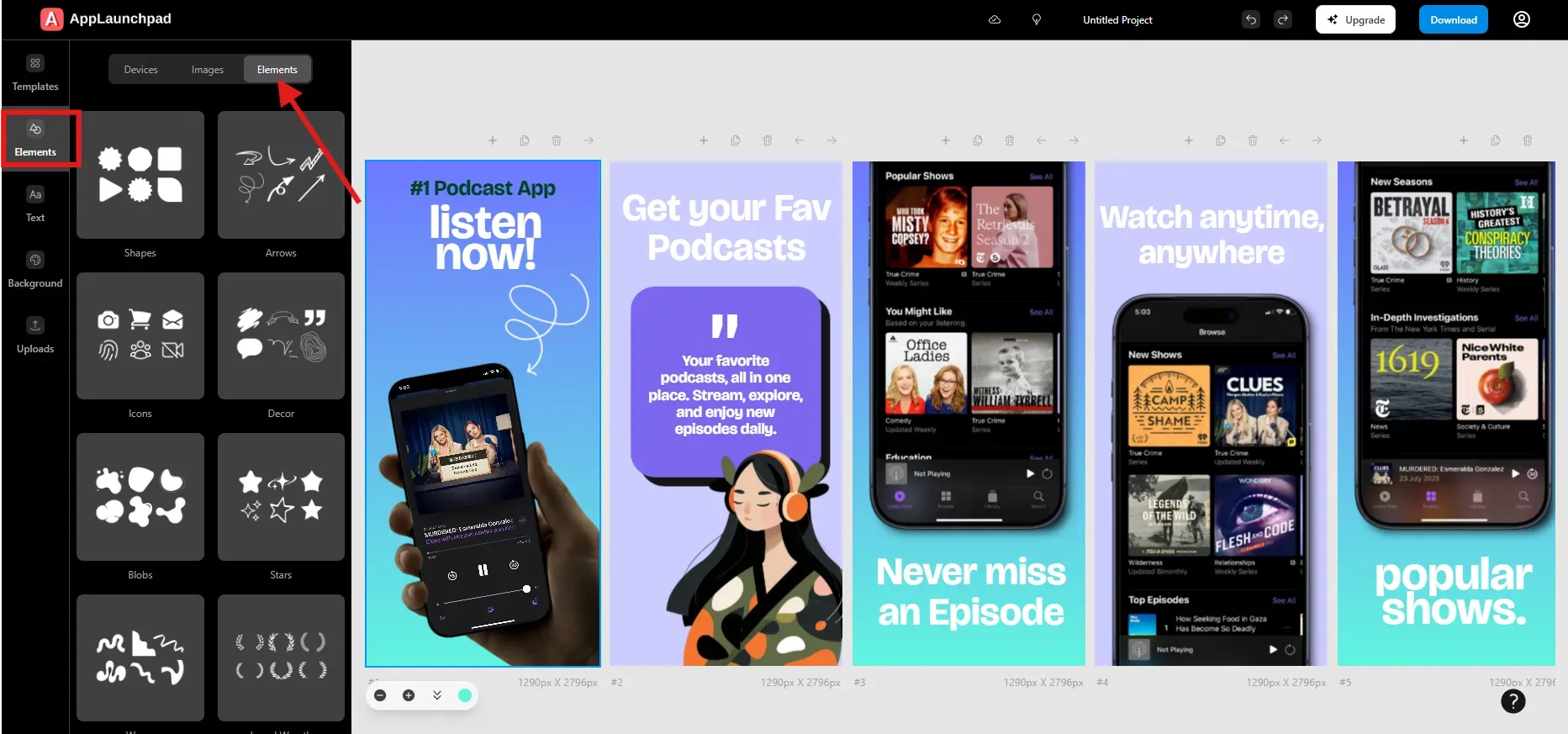
Step 8: Add design elements. Add extra elements like App Store or Google Play badges, Compelling App icons, Illustrations, or design elements. You will find design elements inside the Elements tab.
You can also add brand assets like the Brand logo.
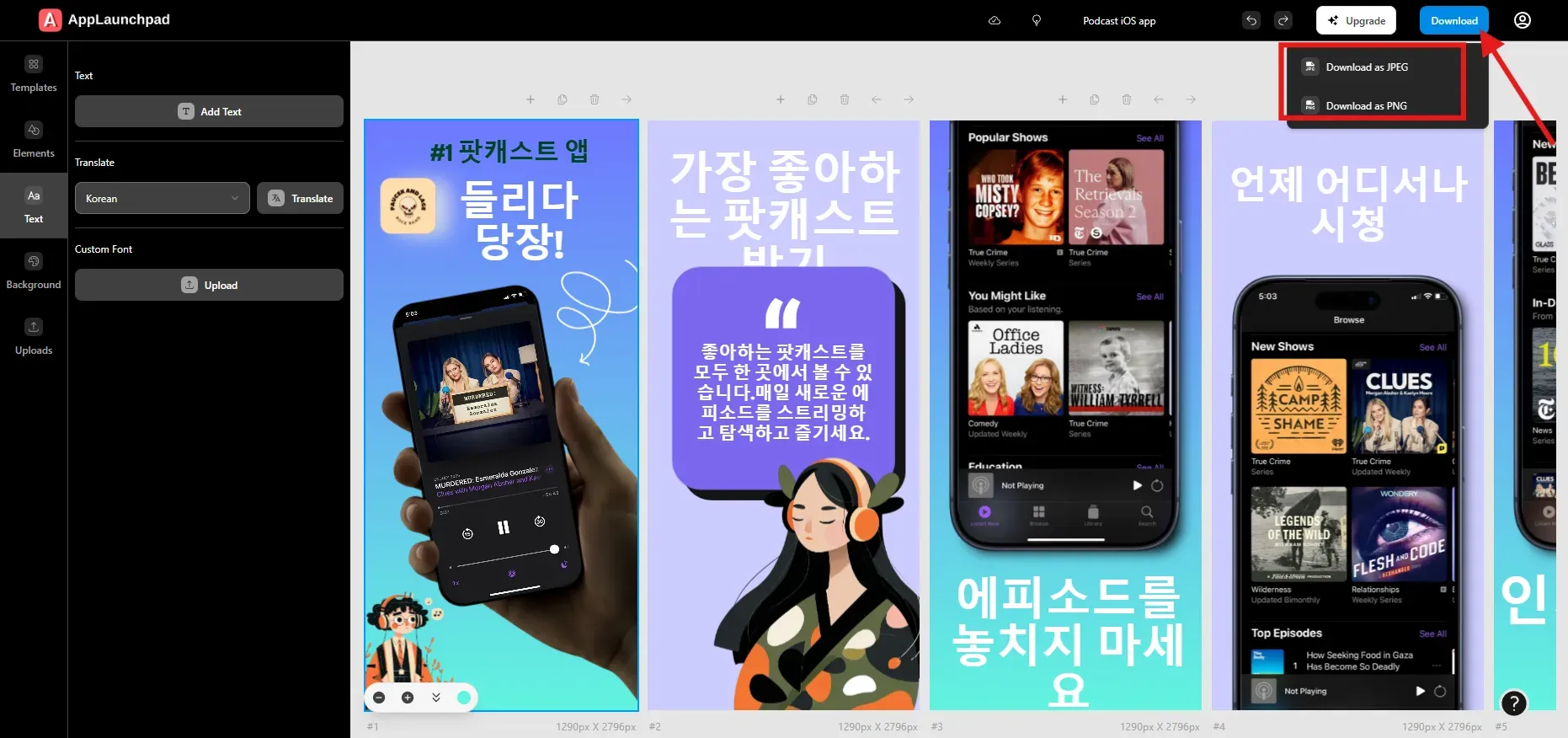
Step 9: Export your screenshots as JPG or PNG. After all editing is done, click on the Download button and select JPG or PNG format. Screenshots will be downloaded as a ZIP file to your local computer.
Note: All projects are automatically saved. You can return at any time to make edits or revisions without starting over.
Conclusion
App Store screenshots play a significant role in how users perceive your app and whether they decide to install it. Clear benefit-focused messaging, readable text, and consistent visuals can make all the difference. Developers love the flexibility to create custom app store screenshots in Figma. At the same time, flexibility often comes at the expense of extra effort.
As apps grow and updates are needed more frequently, creating manual app store screenshots in Figma can slow teams down. This is where developers switch to a purpose-built screenshot tool like AppLaunchpad.
Regardless, the right choice depends on your workflow. If you enjoy hands-on control and are already familiar with Figma, using app store screenshot templates in Figma is the right option. If speed, scale, and compliance are your expectations, AppLaunchpad is a better option. The key is to treat app store screenshots as a growth asset, not a mandate, and choose the tool that doesn’t give you second thoughts.
FAQs
1. AppLaunchpad or Figma: Which Has Better Price-to-Value Metric?
At first glance, Figma appears cheaper because you can start for free. But the real cost is time. Creating App Store screenshots in Figma requires learning design basics, manually adjusting layouts, and repeating the same steps for every update or localization. Over months, those hours tire you out. AppLaunchpad, on the other hand, is priced based on features and results ($15/month billed annually). You pay to get App Store ready screenshots faster, with no design skills and fewer redos.
2. What Are Some Unique Features of AppLaunchpad That Outperform Figma?
AppLaunchpad offers a few unique features, such as smart cloning and AI-powered localization. Cloning makes it easy to create variations of a single screenshot on various devices, while localization helps you translate your app screenshots into multiple languages.
3. How to Create App Store Screenshots in Figma? (Quick Tutorial)
Start by logging into Figma and browsing the Figma Community for free App Store screenshot templates. Add a template to your workspace and customize the screenshot frames. Replace placeholder images with your actual app screens, then update headline text. Adjust colors and the background, preview at smaller sizes, and export each as a PNG or JPG for App Store Connect.
4. Is Figma Feasible for Everyone Designing App Store Screenshots?
Figma works well for developers with some design comfort or teams that already use it for UI work. For beginners or solo founders, the learning curve can slow things down. Simple edits, such as spacing or alignment, may take longer than expected. Figma is fine for one-time launches, but frequent updates can quickly get out of hand.
5. AppLaunchpad or Figma: Which is Better for Localization?
Localization in Figma requires duplicating frames and manually editing text for each language, or using a localization Plugin (external tool). AppLaunchpad simplifies this process with one-click AI-powered localization.